



Browse
Culture And Society
Call for Manuscripts: Utafiti – Journal of African Perspective
Scope
As of 2026 Utafiti is a tri-annual journal, published by the University of Dar es Salaam since 1976. As a premier scholarly publication, the journal specialises in interdisciplinary research that challenges conventional assumptions about Africa and the global human condition. The journal seeks to improve global understandings of African situations, heritages, knowledge production, values, research agenda, priorities and futures, by generating papers from experts based in Africa which constitute scholarship of the highest quality possible, reaching the academic community across all disciplines worldwide. Nonetheless the journal welcomes papers from everywhere, without favouring any institution or affiliation. The primary focus is the highest quality of journal scholarship possible, through careful attention to blind peer reviewers’ feedback, whose verdicts determine acceptance or rejection of a submitted manuscript. The journal preferences critical analysis of both standard or widely received theories and methods. Strictly scientific report formatted articles lie outside the scope of this journal. The journal does not publish sections, distillations or chapters of theses or dissertations.
By prioritising innovative scholarship that centres upon and generates from Africa with particular focus upon and emanating from East African concerns, Utafiti strives to be a vital platform for intellectual exploration and academic innovation inaccessible elsewhere, yet with quality scholarship and expression as our highest priority.
Ethical and Legal Conditions
The publication of a manuscript in a peer-reviewed work is expected to follow standards of ethical behaviour for all parties involved in the act of publishing: authors, editors, and reviewers. Authors, editors, and reviewers should thoroughly acquaint themselves with Brill’s publication ethics, which may be downloaded here: brill.com/page/ethics/publication-ethics-scope-compliance.
Submission Instructions and Requirements
Authors are expected to study and follow these instructions exactly. Failure to do so will delay or defeat your successful and timely submission.
Until an online submission system is in place, please contact with questions and submission of your manuscript, the Chief Editor, Utafiti – Journal of African Perspectives, H. Lauer at helelauer@yahoo.com. For submissions of manuscripts use ONLY THIS same e-mail: helenlauer@yahoo.com. E-mail of the journal’s institutional affiliation is retained for formality. Editor’s phone: +255-743-924-800. Use the editor’s e-mail for all secure and timely correspondence. One may also consult the Editorial Advisor Prof. Andindilile at andindilile.michael@udsm.ac.tz. All typescripts must be in their final form in all respects. The Editors will not submit any typescript to referees which they do not consider to be satisfactory. Manuscripts should be original contributions between 5,000 and 8,000 words including references and abstract of maximum 150 words. Manuscripts are pre-viewed by the editorial team and any submission which contravenes copyright law and scholarly integrity will be immediately returned to the corresponding author with explanation. The journal retains the right to refuse further submissions from anyone who submits plagiarised content in any form.
File Format
Manuscripts intended for publication with Utafiti should be submitted electronically in ‘WORD’ format, double spaced, with wide margins (at least 2.5 cm on all four sides), as measured on standard A4 paper. This rule applies to the entire manuscript, including the reference list, notes and appendix materials—if any. Do not add borders; number your pages.
Manuscript Structure and Format
First page should include the following: (i) title of the article; (ii) name of the author(s) indicating corresponding author listed first, and each author’s title or rank or role in the unit, name of the department or unit within their (iii) institutional affiliation; (iv) personal email address, (v) your ORCID number. Where authors are not affiliated they should identify as Independent Scholar or Independent Researcher, in a town or city and country; (vi) abstract; (vii) key words; please (viii) insure you provide working cell phone numbers for communication with the editor. Phone numbers are not for publishing, but for managing the paper through essential contact by editor in chief with the corresponding author. Begin the main text of the paper on the same page after the key words. Abstract should be no more than 150 words, followed by 4 to 5 Keywords. The title should be succinct, no more than ten words. Running headers will be limited to five words or less.
DECLARATIONS and ACKNOWLEDGEMENTS
At the end of the main narrative, just before the references, author(s) must indicate details of any sources of support, financial or otherwise, which assisted the research and/or the writing of the manuscript or the production of the paper at any earlier point. Authors here must declare any conflicts of interest relevant to the views conveyed in the manuscript. These statements can take many forms, left to the authors’ discretion. When all authors have the same (or no) competing interests and/or funding it is sufficient to use one blanket statement.Examples of statements to be used when funding has been received:
Partial financial support was received from [...]
The research leading to these results received funding from […] under Grant Agreement Number […].
This study was funded by […]
This work was supported by […] (Grant numbers […]
Examples of statements one might use when there is no funding:
The authors did not receive support from any organization for the submitted work.
The author has no competing interests to declare that are relevant to the content of this article. No funding was received to assist with the preparation of this manuscript.
No funding was received for conducting this study.
No funds, grants, or other support was received.
Examples of statements one might use when there is no funding:
The authors did not receive support from any organization for the submitted work.
The author has no competing interests to declare that are relevant to the content of this article. No funding was received to assist with the preparation of this manuscript.
No funding was received for conducting this study.
No funds, grants, or other support was received.
Examples of statements to be used when there are interests to declare:
Financial interests: Author A has received research support from Company A. Author B has received a speaker honorarium from Company Wand owns stock in Company X. Author C is consultant to company Y.
Financial interests: The authors declare they have no financial interests.
Financial interests: Author A received a speaking fee from Y for Z. Author B receives a salary from association X. X where s/he is the Executive Director.
Non-financial interests: Author C is an unpaid member of committee Z.
Non-financial interests: Author A is on the board of directors of Y and receives no compensation as member of the board of directors.
Further Requirements
All typescripts must be in their final form in all respects. The Editors will not submit any typescript to referees which they do not consider to be satisfactory.
Language
Manuscripts may be submitted entirely in English (American or UK), entirely in French or entirely in Kiswahili, whereby spelling should be consequent in the language used. When the manuscript is in Kiswahili or in French, the abstract, key words and the information (i)-(vii) above also appeartranslated in English; this English version of the title et al. appears after the Kiswahili or the French original directly before the main text.
Illustrations
Illustrations (artworks, maps, and photographs) must be set in the text with captions, of high resolution with legible captions. Each manuscript containing ANY inserted material needs to be sent in both WORD version and each insert of a table, graph, map, photograph, plate, drawing, diagram, chart must ALSO be sent as a separate file in its original software version (jpeg, png, EXCEL, or any non-WORD software type of file). Each of these separate files should be titled in the subject box EXACTLY as they are figured or numbered AND captioned in the WORD manuscript file. 300 dpi (= 1 MB) is an absolute minimum for these separate files, to ensure highest quality possible of the journal’s print version. No lower pixel density will be accepted by the publisher.
References
The reference list should appear at the end of the document, arranged in alphabetical order, using the second name of the author, or of the first author in case of multiple authors. See the following examples. DO NOT USE AUTOMATIC BIBLIOGRAPHY WORD PROCESSING FUNCTION KEYS to produce your final reference list. Insert in the manuscript as fixed type. Manuscripts containing automated bibliography lists will be returned to the author immediately for restitution. Most importantly be sure your reference entry is complete and accurate. Cross-check with your narrative to be sure there is one and only one entry for every in-text citation or footnote.
Articles in Journals or Encyclopaedias
Geerling, C. and H. Brenan. 1986. Ecology and development: an attempt to synthesize. Environmental conservation 13: 211-214. Chegere, M., Kidane, A, and Leyaro, V. 2013. Poverty Effects of Fuel and Food Price Changes in Tanzania. Utafiti 10.2: 1-33.
Books
Kjekshus, H. 1977. Ecology control and economic development in East Africa: The Case of Tanganyika 18501950. London: Heinemann. United Republic of Tanzania (URT). 1998. The Constitution of the United Republic of Tanzania of 1977. Dar es Salaam: Government Printer.
Chapters in Books
Masanja, P. and Lawi, Y. 2006. African Traditional Religions. In: Justice Rights and Worship: Religion and Politics in Tanzania. Eds. R. Mukandala, S. Yahya-Othman, S.S. Mushi, and L. Ndumbaro. Dar es Salaam: Mkuki na Nyota, pp. 97-113.
Dissertations
Ferdinand, C. K. T. 1984. An econometric analysis of demand for Chibuku in Dar es Salaam. Unpublished MA thesis, University of Dar es Salaam.
Footnotes
All footnotes should be single spaced. Footnote numbers in the text (numbered consecutively throughout) should be clear (not too small) and should not be accompanied by brackets or other marks. Introduce all footnotes into your WORD document using the WORD function key for footnotes. The number should be in superscript above the line of writing, e.g.63 Footnote markers should be placed after any punctuation that appears at the end of the sentence, phrase or clause to which the footnote is attached. In the footnotes themselves, each note should begin with the footnote number (in superscript and not followed by any full stop or other punctuation).
Mathematical expressions
In case of mathematical expressions (e.g., subscripts and superscripts), they should be correctly placed or clearly marked. Greek letters and unusual symbols should be identified by writing their names in the margin, circling them, at the first occurrence in the paper. Any equation number should go at the right margin. Mathematical symbols for vectors should be labelled as such, e.g., by a wavy underscore.
Accessibility
Brill is committed to ensure our publications are accessible for everyone: brill.com/page/accessibility/access-to-brills-content-for-people-with-disabilities. We advise that you always provide not just captions for your illustrations (if any) but also alt text (alternative text) for each caption. Alt text may be inserted for a description of the illustration for the visually impaired. Tips on how to write good alt texts can be found at support.microsoft.com/enus/office/everything-you-need-to-know-to-write-effective-alt-text-df98f884-ca3d-456c-807b1a1fa82f5dc2. Please submit your alt texts in a separate Word document.
Book reviews
We welcome reviews of books recently published (in the last academic year preceding the volume issue date). These should be maximum 1,200 words; they should contain a description, analysis and appraisal of the book. Avoid disparaging condemnations. Reference lists do not apply in submitting book reviews at the end of the review. Instead when citing other texts refer to these as in-text citations and/or footnotes that are self-contained including full reference information. When citing the text under review, use double quotation marks and include page numbers. Indent completely quoted passages of 3 lines or more and keep extensive quotation to a minimum. The heading of the review should follow this format: Human Rights in Context, by J. Musalyana, 2018, Dar es Salaam: Mkuki na Nyota, xix 350 pp. ISBN 10-43290899X.
Double-Blind Review Methodology
Utafiti employs a rigorous double-blind peer review process designed to ensure the highest standards of scholarly evaluation while minimizing potential biases. This sophisticated approach maintains complete anonymity between authors and reviewers throughout the evaluation process.
The review methodology begins with meticulous manuscript preparation. The editor-in-chief carefully controls the review materials by electronically removing all personal information and metadata, ensuring that reviewers cannot identify the manuscript's authors. Authors are also required to remove firstperson references and any potentially identifying information from their texts, creating a truly anonymous submission. Reviewer selection is a nuanced and thoughtful process. Potential reviewers are initially presented only with the manuscript's title and abstract, allowing them to gauge their interest and expertise without being influenced by author identities. Reviewers are given the professional courtesy to decline review based on various factors such as current workload, potential conflicts of interest, or lack of direct relevance to their area of expertise. The journal seeks out specialists with deep knowledge in specific research areas, recognizing that meaningful review requires both broad academic understanding and specialized insight. Typically, at least two expert referees anonymously evaluate each submitted manuscript. These reviewers are provided with a standardized one-page Q&A review form that ensures comprehensive and structured evaluation while allowing space for detailed commentary. A primary goal of this double-blind review process is to mitigate various forms of potential bias that could inadvertently influence scholarly evaluation. By removing identifying information, the journal seeks to prevent discrimination based on gender, religious affiliation, political perspective, ethnicity, generational differences, or institutional reputation. This approach ensures that manuscripts are judged solely on their scholarly merit, intellectual rigor, and contribution to knowledge. Reviewers may provide tracked comments on the manuscript, which the editor carefully anonymizes before forwarding to the corresponding author. In cases where reviewers provide conflicting assessments, a third reviewer may be consulted to provide additional perspective. Throughout this process, authors are ultimately entitled to see all blind reviewers' comments, promoting transparency and supporting scholarly development.Utafiti is committed to following the advice of international peer specialists in determining manuscript acceptance, with the ultimate goal of maintaining the highest standards of academic publication. This approach reflects a deep commitment to intellectual integrity, fair evaluation, avoidance of institutional bias, and the advancement of the highest quality scholarly discourse.
Guidance for Blind Reviewers and Authors
Reviewers are invited to craft their evaluations using the review form provided by the editor or to submit a detailed critique in their own format. Reviewers are invited to submit tracked comments on the manuscript, which is anonymised and returned to the author promptly, with the review form or narrative. Feedback is intended to be both decisive and instructive, guiding authors in revising their work. Authors are encouraged to acknowledge the input of reviewers and editors in their revised submissions, either directly in their manuscripts or in a footnote. The journal recognises the substantial time commitment peer review entails and expresses its gratitude to reviewers for their invaluable contributions. The collaborative efforts of authors, reviewers, and editors uphold the journal’s mission to advance high-quality scholarship that enriches global understanding of African perspectives.
Publication Proofs
Upon acceptance, an article proof will be sent to authors by e-mail to check carefully for factual and typographic errors. At this stage in the production process, only minor corrections are allowed. Alterations to the original manuscript at this stage will result in considerable delay in publication and, therefore, are not accepted unless charged to the author. Proofs should be returned promptly.
Author Fulfilment
The Author retains the right to self-archive the submitted (pre-peer-review) version of the article at any time. The submitted version of an article is the author's version that has not been peer-reviewed, nor had any value added to it by Brill (such as formatting or copy editing). The Author retains the right to self-archive the accepted (peer-reviewed) version without any embargo period. The accepted version means the version that has been accepted for publication and contains all revisions made after peer reviewing and copy editing but that has not yet been typeset in the publisher’s lay-out. The publisher’s lay-out must not be used in any repository or on any website (brill.com/page/resources_selfarchiving).
License to Publish Publication Agreement
By submitting a manuscript, the author agrees to enter into a publication agreement if and when the article is accepted. For that purpose, the author needs to sign the License to Publish form, which will be sent with the first proofs of the manuscript.
Open Access
Should the author wish to publish the article in Open Access, they can choose non-exclusive Open Access publication under a Creative Commons license in exchange for an Article Publication Charge (APC), upon signing a special Open Access Consent to Publish form. More information on Open Access can be found on brill.com/openaccess.
Read more

By: Yasmine Ben Slimane
Due Date: Dec, 31, 2026
Culture and society
Leave a comment

Call for Papers at JWAH
ALL FOR PAPERS, JOURNAL OF WEST AFRICAN HISTORYThe Journal of West African History (JWAH) is a peer-reviewed, interdisciplinary research journal dedicated to publishing high-quality scholarship on West African history. Positioned at the forefront of new research, JWAH addresses representation gaps by fostering critical scholarship on topics such as women and gender, sexuality, slavery, oral history, popular and public culture, and religion. The editorial board invites submissions that engage diverse topical, theoretical, and methodological approaches. Committed to rigorous analysis and international in scope, JWAH offers a critical intervention in knowledge production. Each issue includes scholarly book reviews, and articles are published in English, French, and Portuguese, with African-language abstracts. JWAH is published by Michigan State University Press.The editorial board invites scholars to submit original article-length manuscripts (not exceeding 10,000 words including endnotes) accompanied by an abstract that summarizes the argument and significance of the work. Review essays should engage the interpretation, meaning, or importance of an author’s argument for a wider scholarly audience. See what we have available for review on our Book Reviews page. Please contact our Book Review Editors at mark.deets@aucegypt.edu, madina.thiam@jhu.edu, or nkesse@clarku.edu for more information.Manuscripts submitted to the Journal of West African History should be submitted online at https://lnkd.in/eDBDg6fX. In order to submit an article, you will have to create an account. The site will guide you through this process.
Contact Email
jwah@msu.edu
Read more
By: Yasmine Ben Slimane
Due Date: Sep, 30, 2026
Culture and society
Leave a comment
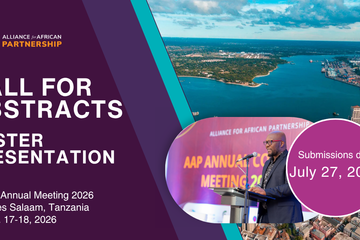
CALL FOR ABSTRACTS FOR POSTER PRESENTATIONS
Poster Call
The Alliance for African Partnership (AAP) invites academic staff, researchers, students, community partners, policymakers, and other stakeholders from AAP and Tanzania Partnership Program (TPP) consortium institutions to submit abstracts for poster presentations at the AAP Annual Meeting 2026. The meeting will be hosted by the University of Dar es Salaam (UDSM) in Tanzania on September 17–18, 2026.
The poster showcase will provide an opportunity to share research, innovations, partnerships, and community-engaged initiatives that contribute to Africa’s development and align with the meeting theme. Posters will be displayed throughout the meeting, while a dedicated Poster Showcase will take place during the Welcome Reception on Thursday, September 17, 2026, from 6:00–8:00 p.m. at the UDSM Auditorium.
AAP particularly encourages submissions that showcase collaborative, interdisciplinary, and impact-oriented initiatives that strengthen higher education and transform lives across Africa.
Annual Meeting Theme
Reimagining Higher Education for Africa’s Future: Leadership, Innovation, and Global Partnerships
Priority Research Areas
Agri-food Systems
Water, Energy, and the Environment
Culture and Society
Youth Empowerment
Education
Nutrition and Health
Science, Technology, and Innovation
Gender and inclusion and sustainability are encouraged as cross-cutting dimensions across all submissions.
Eligibility
Abstract submissions are welcome from:
Academic staff and researchers
Undergraduate and graduate students
Community-based organizations
Civil society organizations
Government agencies
Development partners
Private-sector organizations
Other stakeholders affiliated with AAP, TPP, or partner institutions
Collaborative submissions involving multiple institutions, countries, disciplines, or sectors are strongly encouraged.
Submission Guidelines
Authors should submit an abstract (maximum 300 words) containing:
Title of the poster
Author(s) and institutional affiliation(s)
Corresponding authors contact details (email and WhatsApp number)
Background and objectives
Methods, approach, or project description
Key findings, results, or expected outcomes
Relevance to the Annual Meeting theme and priority areas
Language: English
Submission Format: Microsoft Word (.doc/.docx) or PDF
Review Criteria
Abstracts will be assessed based on:
Relevance to the Annual Meeting theme
Alignment with AAP and TPP priority areas
Clarity of objectives, methods, and findings
Innovation and potential impact
Evidence of collaboration, partnership, or community engagement (where applicable)
Poster Presentation Format
Accepted posters will be displayed at the UDSM Auditorium during the two-day meeting. A dedicated Poster Showcase will be held during the Welcome Reception on Thursday, September 17, 2026, from 6:00–8:00 p.m.
A poster template, dimensions, formatting requirements, and AAP branding guidelines will be shared with accepted presenters. Presenters will be expected to:
Prepare and print a poster summarizing their research, project, innovation, or initiative (printing costs will be borne by presenters unless otherwise communicated)
Display their poster for the duration of the meeting
Engage with participants during the Poster Showcase session
Provide a brief oral explanation of their work if requested
At least one author of each accepted poster must register for and attend the Annual Meeting.
Important Dates
Call for abstracts opens: July 1, 2026
Submission deadline: July 27, 2026
Notification of acceptance: July 31, 2026
Poster template and guidelines shared: Aug 3rd, 2026
Annual Meeting: September 17–18, 2026
Benefits of Presenting a Poster
Poster presenters will have the opportunity to:
Share research, innovation, and best practices with an international audience
Receive feedback from experts, peers, and practitioners
Expand professional and research networks
Explore new collaborative opportunities across Africa and globally
Contribute to knowledge generation and impact-driven partnerships
Submission Process
All poster abstracts should be submitted electronically through the Annual Meeting submission portal.
Submission Link: https://msu.co1.qualtrics.com/jfe/form/SV_79Qa94x9rKw4ksK
For inquiries, please contact: Racheal Ddungu Director, AAP Africa Office Email: racheal.ddungu@mak.ac.ug
Additional Information
Please note that the call does not include travel, accommodation, or poster printing support. Any support arrangements, if available, will be communicated separately by the organizers. By participating in the poster showcase, presenters consent to the photography and dissemination of their poster content for reporting, communication, and promotional purposes, unless otherwise indicated.
Read more
By: Yasmine Ben Slimane
Due Date: Jul, 27, 2026
Culture and society
+1
Leave a comment

No Preview Available
Siyabonana - Special Issue Call for Papers - Through These Eyes: Views of the African Continent
About the Journal
Siyabonana: The Journal of Africana Studies is an open access online peer-reviewed academic journal that publishes original research and creative intellectual work on key issues within the discipline of Africana Studies and across the global African world. Pan-African in scope, the journal publishes research articles, essays, commentaries, institutional reports, book reviews, oral histories/interviews, and other creative work that utilizes African-centered theories, methodologies, and approaches to not only examine critical issues, but to present solutions within all areas of Africana Studies, including the humanities, arts, and sciences. It simultaneously provides intellectual space for discourse about community social justice activist work and liberation struggles on the continent and within African world communities.
The Special Issue Through These Eyes: Views of the African Continent
All photography takes place somewhere, but only some photography makes that place the focal point. “Through These Eyes: Views of the Continent” is a special photojournalism edition of Siyabonana that elicits images and reflective essays regarding photos of the continent of Africa. This special edition of the journal calls for scholarship that uses photography as a medium in conjunction with short personal reflections to document, transform, and expand our imaginings and visualization of the African continent. By investigating photography’s relation to place, this issue explores photography as a medium and tool for placemaking that shapes our understanding of the physical, social, and cultural landscapes of the continent. We seek to loosen categories such as “photojournalism,” or “snapshot,” in favor of broader considerations about the multiple ways photographs function. The goal of the conversation is to expand histories; explore new methodologies; identify repositories; and build scholarly community.
This special edition welcomes proposals from all disciplines with photographs of and reflections on the African world that engage with, but are not limited to, the following themes:
Historical representations of place;
Time and temporality in place-based photography;
Negotiations of myth, fiction, and reality in place-based photography;
Tensions between site-specific, regional, national, and global representations of place;
Photographic responses and remediations of places from other media, including film, literature, and video games;
Interdisciplinary practices and theories in the study of place-based photography;
Ethical considerations and responsibilities of photographing place;
Memory, nostalgia, imagery, and place;
Place, imagery, and spirituality;
Gendered spaces and place; and
(Dis)connections between imagery and space.
Special Issue Editor
Dr. Keisha A. Brown is Associate Professor of History at Tennessee State University in the Department of History, Political Science, Geography, and Africana Studies, and serves on the Editorial Board of The Journal of Africana Studies. She graduated with her bachelor’s degree from the University of Notre Dame; earned her doctorate from the University of Southern California; in 2018–2019, she served as postdoctoral fellow at the James Weldon Johnson Institute for the Study of Race and Difference at Emory University; and was a National Committee on U.S.-China Relations Public Intellectual fellow. Dr. Brown is an Asian Studies scholar with a regional focus on East Asia, and specializing in modern Chinese history. Her research centers on Sino-Black relations, and examines networks of difference in China used to understand the “Black foreign other.” In 2020, she co-founded the Black China Caucus, a non-profit organization dedicated to amplifying Black voices in the China space.
Submission Guidelines*
For this special issue, the editor is asking for authors to submit a 250- 300 word abstract for initial consideration before submitting a longer work. The abstract should include the tentative title, author(s), affiliation(s), detailed summary of the proposed submission, associated photograph(s), and representative sources. All visuals and photos must be taken by the author or creative; the journal is unable to publish photos that have been published elsewhere or that have a previous copyright. AI generated photographs will not be accepted.
Abstracts are due no later than August 31, 2026, and decisions on acceptance will occur no later than October 15, 2026. The selection criteria will involve relevance to the theme, clarity of the paper, intellectual significance, and originality.
After the editor accepts the abstracts, authors must submit completed work by January 31, 2027. The guidelines for submission include a title page with the submission title; the type of submission (research article, interview, etc.); the author's name(s); affiliation(s); and contact email. Manuscripts must be submitted as a Microsoft Word document, double spaced, written in Times New Roman, size 12 font, and comply with the most recent edition of the Chicago Manual of Style, APA Publication Manual, or MLA Handbook in terms of format and citation. The final paper submission should not exceed 25 pages via MS word, including notes and citations.
Submission Timeline
Abstracts Due: August 31, 2026
Notifications to Authors: October 15, 2026
Completed Articles Due for Initial Review: January 31, 2027
Final Submission Date: May 31, 2027
Special Issue Publication Date: Fall 2027
Abstract Submission:
All abstracts and final submissions should be submitted to the special issue editor,
Dr. Keisha Brown: keishab241@gmail.com.
For inquiries directly to the journal, please contact us at https://www.journalofafricanastudies.com/contact.
Contact Email
keishab241@gmail.com
URL
https://www.journalofafricanastudies.com/call-for-papers
Read more or reply
Repost
Read more
By: Yasmine Ben Slimane
Due Date: Aug, 31, 2026
Culture and society
+1
Leave a comment

No Preview Available
Call for Proposals: How to Be a Global Humanist
How to Be a Global Humanist begins with the tension built into its title. The humanities, as an academic field, emerged through Western histories of learning and the institutions that made those histories legible as scholarship. Yet the practices gathered under that name exceed that narrow genealogy. Across the world, people have made meaning from language and image. They have preserved the past, taught inherited forms of wisdom, and argued over what human life is for. Such work does not need the construct of “the humanities” to authorize it. The better question is what the category reveals about the traditions it encounters, and what it renders difficult to see. This volume thus asks how humanistic inquiry can be approached globally without allowing the familiar language of the humanities to flatten the intellectual worlds it seeks to understand.
This volume seeks proposals from scholars working in disciplines traditionally understood as humanistic. It aims to probe the promise and difficulty of calling the humanities global. Essays may address any aspect of the question, from the theoretical—what does the category of the humanities make possible? what does it distort? how have different intellectual traditions understood humanistic inquiry?—to the practical—where is humanistic work done, and under what conditions? how do language, access, and institutional form shape what becomes visible as humanistic inquiry? how can humanists build more globally inclusive forms of teaching, publication, translation, and scholarly exchange? Essays may take a historical or contemporary perspective; comparativist approaches are especially welcome when they put pressure on the category of the humanities itself.
Essays should be approximately 4,500 words. Please send proposals of 200–300 words, along with a brief bio, to the volume editors at editors Hayley Cotter (hcotter@umass.edu) and Tracey Miller-Tomlinson (tomlin@nmsu.edu) by September 30, 2026. Contributors will be notified of decisions by October 31, 2026. Accepted contributions will be due by March 31, 2027.
Contact Information
Hayley Cotter
Contact Email
hcotter@umass.edu
Read more or reply
Repost
Read more
By: Yasmine Ben Slimane
Due Date: Sep, 30, 2026
Culture and society
+1
Leave a comment
No Preview Available
Call for Papers: Workshop – Homes for the Future? Housing and International Development
Subject Fields
African History / Studies, Architecture and Architectural History, Colonial and Post-Colonial History / Studies, Cultural History / Studies, Urban Design and Planning
We invite colleagues from around the world to submit paper abstracts for participation in a workshop exploring development housing from a fresh, interdisciplinary perspective:
Workshop – Homes for the Future? Housing and International Development
Date: Friday 16 October 2026
Location: Utrecht University, The Netherlands
In 2015 the UN laid out seventeen Sustainable Development Goals, including the goal to ‘make cities and human settlements inclusive, safe, resilient and sustainable’.[1] Eleven years on, these goals seem increasingly unattainable. Drastic cuts by Western governments to international relief funding, a global housing crisis, and the systematic destruction of housing in war zones have put both development aid and housing back on the agenda.[2] What, if anything, can we learn from the past?
Development housing – from ‘model villages’ to disaster relief housing – has a long and multifaceted history.[3] UN Housing Missions, such as the 1954 Gold Coast (Ghana) mission, are key moments in this history, but it is also worth taking a broader temporal and geographical view of ‘development’, or ‘humanitarian’ housing.[4] Housing projects in the Global South were not just part of the postwar agenda of the United Nations (UN-HTCP) and the World Bank, but also of other agents in earlier decades such as colonial officers, missionaries, and indigenous elites. Moreover, housing was, and is, more than simply an economic measure or an experiment in architecture and city planning. It was a socio-cultural phenomenon that had far-reaching motivations and influences. Housing projects affected lives and livelihoods, ways of living and homemaking, touching on fundamental questions of belonging and societal marginalization.
In this workshop, we aim to take a fresh, interdisciplinary look at development housing, linking histories of the built environment with legacies of global ‘development’ as well as studies of (the) home and migration.
What should we consider to be ‘development housing’? How far can we stretch the temporal parameters for this concept to still be useful? Are there other concepts that might be better suited?
Looking at this issue from the perspective of the Global South, what impact did some of these development initiatives have on local politics, social structures and everyday life? To what extent was ‘development’ housing an import from the West, or a concept shaped by local actors themselves?
And finally, to what extent can dwellings constructed as part of these development initiatives be considered ‘homes’? How were they made into ‘homes’ and by whom? And what sorts of legacies have they left behind?
We thus have three main aims with this workshop:
To map the global scope of development housing schemes and become better aware of geographical breadth. We see this as a first step toward a broader genealogy of development and/or humanitarian housing.
To better understand their legacies, not just in Western architectural history, but also in local environments. We thus aim to gauge the extent to which such projects were impactful, transformative, and/or meaningful to those involved in their realization and habitation.
To rethink the resulting physical structures through the experiences of their inhabitants, thus linking the realms of politics and architecture with social and cultural histories of everyday life.
We welcome contributions that resonate with these aims. These may include, but are not limited to:
Small-scale and/or privately funded initiatives
Temporary housing as well as more permanent housing projects
Moral and normative implications of development housing projects and their reception
South/South collaboration and socialist solidarity projects
Questions of use, preservation, and the entangled cultural heritage of these buildings
Please submit an abstract of ca. 300 words and a short CV by 15 August 2026 to Lourens Crielaard (l.s.crielaard@uu.nl).
We welcome contributions from early career researchers.
For questions please contact: Lourens Crielaard (l.s.crielaard@uu.nl) or Britta Schilling (b.schilling@uu.nl)
----------------------------------------------------------------------------------------------------------------------------------------------------------------------------------------
[1] United Nations Department of Economic and Social Affairs, Sustainable Development, Goal 11, https://sdgs.un.org/goals/goal11
[2] See, e.g., the UN World Cities Report 2026: The Global Housing Crisis: Pathways to Action, https://unhabitat.org/world-cities-report-2026
[3] Kate Stohr, ‘100 Years of Humanitarian Design’, in Design Like You Give a Damn: Architectural Responses to Humanitarian Crises, ed. by Architecture for Humanity (New York: Metropolis Books, 2006), 32-55; Richard Harris and Godwin Arku, ‘Housing and economic development: the evolution of an idea since 1945’, Habitat International 30 (2006): 1007-1017, p2.
[4] E.g., Mark Crinson, Modern Architecture and the End of Empire (Aldershot: Ashgate, 2003), 130; Mónica Pacheco, ‘Rehearsing experts and ‘inperts’: crossing transnational housing narratives in West Africa’, Planning Perspectives, 37,5 (2022): 921-948; A Scott Henderson, Housing and the Democratic Ideal: The Life and Thought of Charles Abrams (New York/Chichester: Columbia UP, 2000), 173-192; Tom Avermaete and Charlotte Robinson, ‘Betaalbaar wonen als ontwikkelingshulp/Affordable housing as development aid’, DASH 12/13 (2016): 20-35; see also ABE Journal. Architecture beyond Europe, nos. 21 and 22 (Summer and Winter 2023).
Contact Information
Lourens Crielaard
Contact Email
l.s.crielaard@uu.nl
Attachments
cfpworkshophomes-future.pdf
Read more
By: Yasmine Ben Slimane
Due Date: Jul, 16, 2026
Culture and society
+1
Leave a comment
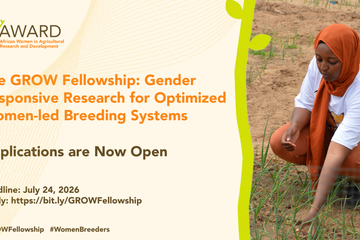
Call for Applications for the Inaugural Cohort of the GROW Fellowship
The Call for Applications for the GROW Fellowship: Gender Responsive Research for Optimized Women-led Breeding Systems is now open. Targeting women breeders in Africa, the GROW Fellowship seeks to contribute to more gender-responsive crop improvement systems by strengthening the leadership pipeline of women professionals working in plant breeding and related fields.
The immersive non-residential Fellowship seeks to accelerate the leadership, visibility, and career advancement of women breeders by strengthening their capacity to lead gender-responsive breeding research, influence scientific and policy agendas, and become recognized leaders driving crop and livestock improvement efforts on the continent.
The Fellowship targets African women breeders who are actively engaged in crop improvement research and development. Participants will be drawn from universities, national agricultural research systems (NARES), the private sector, and other institutions involved in crop breeding.
Who Should Apply?
The Program seeks applications from women professionals who:
Are citizens of any African country;
Hold at least a Master’s degree in plant or livestock breeding and actively engaged and practicing in this field;
Have at least 5 years of experience in crop or livestock improvement research;
Are affiliated with universities, national agricultural research institutions, private companies or other organizations involved in crop improvement;
Are available and committed to participating fully in all Fellowship activities offered over a two-year period;
Are not currently participating in other AWARD Fellowships.
Fellowship Activities
Successful applicants will participate in a series of face-to-face and virtual activities, including:
Leadership and negotiation skills training;
Structured mentoring program;
Knowledge forums and networking opportunities;
Peer learning sessions in a growing network of women professionals in crop improvement and agricultural research.
How to submit your application
Applications must be submitted strictly via this online portal. Apply Here
Applications must be submitted no later than July 24, 2026, at 23:59 East Africa Time (GMT+3).
Applications will NOT be accepted after this deadline.
Applicants are encouraged to carefully review the application guidelines for detailed information on eligibility requirements and the application process.
Download the Application Guidelines
Download the Program Brochure
Download the Frequently Asked Questions (FAQs)
The GROW Fellowship is part of the Gender Responsive and Women Led Research and Development Program funded by the Gates Foundation and implemented by African Women in Agricultural Research and Development (AWARD) in partnership with the Gender-Responsive Researchers Equipped for Agricultural Transformation (GREAT), Makerere University, and Cornell University.
Read more
By: Yasmine Ben Slimane
Due Date: Jul, 24, 2026
Agri-food systems
+1
Leave a comment

No Preview Available
Applications open for Women in Tech Incubator (South Africa)
Deadline: Jun 26, 2026
Donor: WomHub
Grant Type: Training
Grant Size: $1000 to $10,000
Countries/Regions: South Africa
Area: Business & Industry, Entrepreneurship, Startups, Innovation, Leadership, Gender Equality, Women & Gender
The Women in Tech Incubator South Africa is requesting applications to support women innovators in STEM with resources, training, and business development opportunities.
For more information, visit https://www.womhub.com/scwomenintech4.html
Premium Link: https://grants.fundsforngospremium.com/opportunity/op/applications-open-for-women-in-tech-incubator-south-africa
Read more
By: Yasmine Ben Slimane
Due Date: Jun, 26, 2026
Culture and society
+2
Leave a comment

No Preview Available
Applications open for SparkChange Programme (Uganda & Tanzania)
Deadline: Jun 30, 2026
Donor: DW Akademie
Grant Type: Training
Grant Size: Not Available
Countries/Regions: Tanzania, Uganda
Area: Capacity Building, Individuals, Leadership, Women & Gender, Youth & Adolescents
The DW Akademie is seeking committed community champions from rural and peri-urban areas in Uganda and Tanzania who have a strong idea for expanding their impact.
For more information, visit https://akademie.dw.com/en/uganda-tanzania-apply-now-for-sparkchange/a-77429906
Premium Link: https://grants.fundsforngospremium.com/opportunity/op/applications-open-for-sparkchange-programme-uganda-and-tanzania
Read more
By: Yasmine Ben Slimane
Due Date: Jun, 30, 2026
Culture and society
+1
Leave a comment

Business History Special Issue – Call for Papers
Theme
Indigenous Entrepreneurship under Colonialism and Beyond:Institutional Negotiation, Exclusion and Resilience
Looking for papers on
Indigenous entrepreneurship
Colonialism
Business history
Consumer culture
Markets
Institutions
Entrepreneurship
Timeline:
Informal enquiries welcome: June-September 2026
Abstract / proposal deadline (800–1,000 words)
1 October 2026
Decisions on abstracts
1 November 2026
Paper-development workshop(s)
Newcastle Business School, Northumbria University
Full paper submission deadline
1 May 2027
First-round peer-review decisions
September 2027
Revised paper deadline
1 February 2028
Final revision deadline
1 May 2028
Final acceptance target
June 2028
Expected online publication and launch
Autumn 2028
Expected print publication
Early to mid-2029
Submission Requirements: Authors are invited to submit an extended abstract or proposal for initial consideration. Submissions should be approximately 800–1,000 words and clearly set out the article’s research question, historical scope (including timeframe and location), sources and methodology, and anticipated contribution to the literature. Please also provide a tentative title, author name(s), affiliation(s), and contact information.
Proposals should be sent by 1 October 2026 to himadri@xlri.ac.in, with the other editors copied in: marktadajewski@gmail.com, andrew.perchard@otago.ac.nz, and zpittaki001@dundee.ac.uk. The email subject line should read: “CFP – Indigenous Entrepreneurship under Colonialism and Beyond Special Issue.”
Formatting and Length: Final papers should adhere to Business History guidelines (typically in the range of 8,000–10,000 words, including notes and references). Authors will be provided detailed instructions for manuscript preparation upon acceptance of proposals. We welcome informal inquiries if you have questions about the fit of a topic or the preparation of your proposal. All articles will be submitted through the Submission Portal for the journal in order to be peer-reviewed before acceptance for publication.
Read more
By: Yasmine Ben Slimane
Due Date: Oct, 1, 2026
Culture and society
+1
Leave a comment
No Preview Available
NCSA Article Prize
Award Amount
$500
Eligibility
Anyone with a qualifying scholarly article on the long nineteenth century.
Requirement
Published article in:
2025
January–June 2026
Link https://ncsaweb.net/ncsa-article-prize/Deadline
📅 July 1, 2026
Read more
By: Yasmine Ben Slimane
Due Date: Jul, 1, 2026
Culture and society
+1
Leave a comment

Journal of the History of Ideas Graduate Student Symposium 2026
Theme
"Prophecy, Prediction, and the Politics of Futurity"
What it is
A graduate-student-only symposium where accepted participants present article-length papers and receive feedback from editors.
Format
Virtual (Zoom)
October 17, 2026
Eligibility
Graduate students at any stage.
Benefits
Present your work
Receive editorial feedback
Network with scholars
Strengthen future publication prospects
Application Requirement
Abstract under 500 words.
Deadline
📅 June 22, 2026
Key details regarding the event:
Abstract Submission: Applicants must submit a 500-word abstract to blogjhi@gmail.com.
Email Subject Line: Must include "Symposium Abstract".
Event Structure: Accepted students will pre-circulate their papers, present on a panel, and receive direct feedback from peers and Journal of the History of Ideas editorial board members.
Precirculation Deadline: Accepted students will need to send a journal-length paper by October 2, 2026. [1, 2]
For detailed guidelines and thematic context, you can read the official JHI Graduate Student Symposium 2026 Call for Proposals. [1]
Read more
By: Yasmine Ben Slimane
Due Date: Jun, 22, 2026
Culture and society
+1

Leave a comment