

Browse
Culture And Society
Attached to the Soil
Attached to the Soil was begun during my 7-month Fulbright Scholar service in South Africa in 2019, inspired by the aspirational metaphor that President Nelson Mandela shared in the first words of his 1994 Inaugural Address. Collaborating with youth who proposed their own soil-related metaphors regarding their perception of realities in South Africa's past, present, or future, the stories of their fellow South Africans were told through portraiture and stories drawn from oral history interviews. The 50 works have been exhibited in 6 university art galleries across South Africa, and hung for 8 months in the Nelson Mandela Foundation's Centre of Memory, Houghton, Johannesburg. It is a model that I would like to extend not only in South Africa but in service to youth across Africa.
By:
Peter Glendinning
Thursday, Apr 4, 2024
CULTURE AND SOCIETY
+1
Leave a comment
Technology as a Tool of Enhancing Public Confidence in Elections in Africa | AAP Dialogue Series
Recorded on October 27, 2022 as part of AAP Public Dialogue Series
By:
Justin Rabineau
Tuesday, Feb 21, 2023
CULTURE AND SOCIETY
Leave a comment
New open access book: Rethinking Heritage for Sustainable Development (UCL Press)
UCL Press is delighted to announce the publication of a new open access book that may be of interest to list subscribers.
Rethinking Heritage for Sustainable Development, by Sophia Labadi.
The Sustainable Development Goals (SDGs) adopted by the UN in 2015 have influenced the actions of international and intergovernmental organisations and governments around the world, and have dictated priorities for international aid spending. Culture, including heritage, is often presented as fundamental to addressing the SDGs: since 2010, the United Nations has adopted no fewer than five major policy recommendations that assert its importance as a driver and enabler of development. Yet, heritage is marginalized from the Sustainable Development Goals.
Rethinking Heritage for Sustainable Development constitutes a substantial and original assessment of whether and how heritage has contributed to three key dimensions of sustainable development (namely poverty reduction, gender equality and environmental sustainability) within the context of its marginalisation from the Sustainable Development Goals and from previous international development agendas.
Sophia Labadi adopts a novel, inclusive, large-scale and systematic approach, providing the first comprehensive history of the international approaches on culture (including heritage) for development, from 1970 to the present day. This book is also the first to assess the negative and positive impacts of all the international projects implemented in sub-Saharan Africa by a consortium of UN organisations that aimed to provide evidence for the contribution of heritage for development in time for the negotiation of the SDGs. The book’s conclusions provide recommendations for rethinking heritage for development, while reflecting on the major shortcomings of the selected projects.
Free download: https://bit.ly/3m10NRK
By:
Raquel Acosta
Monday, Jun 13, 2022
CULTURE AND SOCIETY

No Preview Available
Leave a comment
Feminist Africa, Volume 2, Issue 2 (2021): Gender and Sexuality in African Futurism
The newest issue of Feminist Africa is now available! The theme of the issue is "Gender and Sexuality in African Futurism." You can access the full issue at Current Issue - Feminist Africa. Learn more about Feminist Africa here.
TABLE OF CONTENTS
Editorial: Gender and Sexuality in African Futurism
· by Jacqueline-Bethel Tchouta Mougoué
Feature Articles
“How to Save the World from Aliens, Yet Keep Their Infrastructure”: Repurposing the “Master’s House” in The Wormwood Trilogy
· by Jenna N. Hanchey and Godfried Asante
When the Lagoons Remember: An Afroqueer Futurist Reading of “Blue Ecologies of Agitation”
· by Kwame Edwin Otu
“One Foot on the Other Side”: An Africanfuturist Reading of Irenosen Okojie’s Butterfly Fish (2015) and Akwaeke Emezi’s Freshwater (2018)
· by Kelsey Ann McFaul
Haunted Airports and Sexual Anxieties in Nana Nyarko Boateng’s “Swallowing Ice”
· by Delali Kumavie
Africanfuturism and the Reframing of Gender in the Fiction of Nnedi Okorafor
· by Arit Oku
Standpoint
The Liquid Space where African Feminism and African Futurism Meet
· by Minna Salami
Fiction
Land of My Dreams
· by Juliana Makuchi Nfah-Abbenyi
Exhibition
The Afrofuturist Village
· by Masiyaleti Mbewe
Reviews
“Liberation is Necessarily an Act of Culture”: A Review of Spirit Desire
· by Luam Kidane
Methodologies in Caribbean Research on Gender and Sexuality
· by Sylvia Tamale
Fashioning Postfeminism: Spectacular Femininity and Transnational Culture
· by Rosemary Oyinlola Popoola
By:
Raquel Acosta
Tuesday, Jan 4, 2022
CULTURE AND SOCIETY
+1

No Preview Available
Leave a comment
AAP Members engage SADC Chief
Four members of the Alliance for African Partnership (AAP) – the Lilongwe University of Agriculture and Natural Resources (LUANAR), University of Pretoria (UP), University of Botswana (UB) and University of Dar re Salaam (UDSM) – have engaged the SADC secretariat for partnership in a number of areas of development for the region.
The delegation, which included LUANAR Vice Chancellor Prof. Emmanuel Kaunda, engaged the recently elected SADC Executive Secretary Elias Magosi to discuss collaboration.
SADC Executive Secretary Elias Magosi
The leaders sought the attention of SADC, in partnering with universities on research in seven areas including youth empowerment which is also the focus of SADC Chairperson, Malawi President Lazarus Chakwera.
In his remarks, Professor Kaunda said LUANAR is a Center of Excellence in a number of areas including aquaculture and fisheries which is recognised by the World Bank and yet has no significant recognition from the regional bloc.
“We have seen a little bit of disjoin there on how these centers can support the regional SADC agenda. Already we are offering PhDs and Master to students from 19 countries,” he emphasised.
This was echoed by Professor Swanepoel who represented UP, touching on the importance of collaboration as being key to regional integration.
Further, the universities want to work with SADC in areas of Human Capital Development, Centers of Excellence and Specialization, Policy dialogues, Gender, Science and Technology, Trade and Regional Integration and Engagement and empowerment of civil society organizations and other non-state actors,
According to Prof. Mkandawire, AAP Africa Director, who hosted the meeting, this is the first time a group of VCs has dated SADC and hoped that “this move will improve the way SADC works with universities.”
“Universities are key in human capital development for Africa through education and training. In addition, universities play a key role in the generation of knowledge through research, policy analysis and other types of analytical work,” he said.
Accordingly, said Mkandawire, VCs from SADC universities have joined efforts to deepen conversations with a focus on how institutions of higher learning can better contribute towards the advancement of SADC’s development frameworks.
In his immediate response, SADC ES, Magosi, said the meeting and the VCs' asks are “a very encouraging starting point” between the universities and SADC secretariat.
He noted the importance of Centers of Excellence as an important aspect to advance collaboration at a regional level suggesting a need to identify the available to build on and start others to close available gaps with focus on specific specialisation.
Among other calls, the VCs pointed out the need to define mechanisms of engagement between SADC secretariat and institutions of Higher learning, Centers of Excellence, and research Institutes in the implementation of SADC’s Regional Indicative Strategic Development Plan (RISDP).
Further, VCs propose to engage with SADC on how expertise within the universities, Think Tanks and Centers of Excellence can be utilized to shed light on the impact of processes related to regional integration and the Africa Free Trade Agreement.
The leaders also want to work with SADC on a region wide program to develop the capacity of early career female researchers to initiate and manage research projects as well as communicate research to policy makers and broader audiences.
By:
Raquel Acosta
Wednesday, Nov 17, 2021
CULTURE AND SOCIETY
+1

Leave a comment
USAID Administrator Samantha Power: A New Vision for Global Development
USAID Administrator Samantha Power delivers remarks outlining a bold vision for the future of the U.S. Agency for International Development (USAID) and inclusive development around the world. The speech takes place as USAID celebrates its 60th anniversary. Administrator Samantha Power's remarks will be followed by a conversation with 2020 USAID Payne Fellow Katryna Mahoney
By:
Derek Tobias
Thursday, Nov 4, 2021
AGRI-FOOD SYSTEMS
+5
Leave a comment
Mali’s roadmap for lasting peace has laudable goals: but it doesn’t go far enough
Steve Esquith, one of the PIs during the first round of AAP Transformation Institutions Strategic Partnership Grants and an African Futures mentor, has recently published an article within @TheConversation. This article is related to his peace-building work achieved under the grant. We encourage colleagues to read through his review of Mali’s new government action plan.
Read the article: https://theconversation.com/malis-roadmap-for-lasting-peace-has-laudable-goals-but-it-doesnt-go-far-enough-166419
By:
Raquel Acosta
Tuesday, Sep 14, 2021
CULTURE AND SOCIETY

Leave a comment
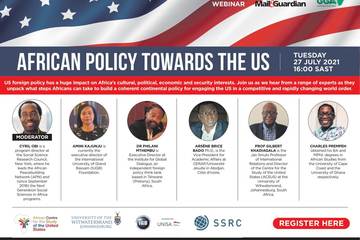
African Policy towards the US webinar
The African Centre for the Study of the United States, in collaboration with Good Governance Africa,
The Institute for Global Dialogue, Social Science Research Council and the Mail and Guardian, present: African Policy towards the US webinar
Date: 27 July 2021
Time: 4:00pm SAST / 10:00am EDT
US foreign policy has a huge impact on Africa’s cultural, political, economic and security interests. Join us as we hear from a range of experts as they unpack the steps Africans can take to build a coherent continental policy for engaging the US in a competitive and rapidly changing world order.
Registration Link for Webinar
https://mg.co.za/africa-us-policy/
For more information on the African Centre for the Study of the United States visit: https://www.wits.ac.za/acsus/
For further inquiries, please contact ACSUS.research@wits.ac.za
Find us on Twitter Facebook and Linkedin
By:
Madeleine Futter
Monday, Aug 16, 2021
CULTURE AND SOCIETY
Leave a comment
Conference: A Call for the Desuperiorization of Philosophy and the Foundation of Superaltern Studies
A Call for the Desuperiorization of Philosophy and the Foundation of Superaltern Studies
August 11-13
About the conference
It seems Western thought, to this day, has not sufficiently recognized its superioristic danger as the danger that it is! When considering contemporary contexts, this danger remains real. The foreign, the other, is stigmatized or re-stigmatized. Western thought remains dangerous. The West must finally take this seriously and critically evaluate its value as a normative authority. It would hardly be surprising if we indeed find that a lot of contemporary problems have grown forth from the pseudo-self-evident superiority of the white, heterosexual, male human being many of the Enlightenment thinkers tried so vigorously to defend by manipulating philosophy. The West needs to understand itself, needs to understand all the intricacies of its superiorism, its superalternity and finally start working on the desuperiorization of its thought. We want to stimulate a discussion that Western thought must understand that its central task must be its Desuperiorization. We need to establish Superaltern Studies. We need to understand the superiorism of Western thought. We need to understand it deeply to be able to identify and avoid it. We need to understand why Western thought and Western action so often brought exploitation and humiliation with it. The Enlightenment did not only introduce a new understanding of the value of the human being, it also introduced a new level of dehumanization. Philosophy did not only argue to treat all human beings humanely, it – implicitly and explicitly – worked at the same time on reducing the numbers of those who were human enough to be treated humanely. This seems to have been one the most important intellectual self-deception moves that enabled so many philosophers to be humanist and anti-humanist at the same time: to simply disregard the humanness of those mistreated. We want to understand how superiorism has, and continues to play out, in terms of the colonialism and neocolonialism that has continued to affect much of the global south. We need to see how decoloniality expresses itself, and should express itself, as a necessary response to superiorization and inferiorization, as well as the psychological baggage that comes with it. We need to also examine the epistemological effects of superiorization, which has presented itself in what scholars have termed epistemic injustice, epistemic harm, and/or epistemic violence. How has this affected scholarship and knowledge production and must it be resisted? How do we balance identity and pride with the devastating effects of superiorization and othering?
Speakers
Robert Bernasconi, Pennsylvania State University, USA
Benda Hofmeyr, University of Pretoria, South Africa
Elvis Imafidon, University of London, England
Janine Jones, University of North Carolina at Greensboro, USA
Siseko Kumalo, University of Pretoria, South Africa
Dimpho Takane Maponya, University of Johannesburg, South Africa
Veli Mitova, University of Johannesburg, South Africa
Ana Paula Coelho Rodrigues, University of Paderborn, Germany
Boaventura des Santos Sousa, University of Coimbra, Portugal
University of Wisconsin-Madison, USA
Natsu Taylor Saito, Georgia State University, USA
Abraham Tobi, University of Johannesburg, South Africa
Mpho Tshivhase, University of Pretoria, South Africa
Organization Committee
Björn Freter, Independent Researcher, Knoxville, TN, USA
Aribiah Attoe,
Conversational Society of Philosophy,
South Africa
For any questions, please write to
desuperiorization@gmail.com
The event will be held online. Please register here
https://www.desuperiorization.com/
By:
Madeleine Futter
Monday, Aug 16, 2021
CULTURE AND SOCIETY
No Preview Available
Leave a comment
The Sixth J. A. Atanda Lectures and Conference - Fourth Conference Update
THE SIXTH J. A. ATANDA LECTURES AND CONFERENCE
Fourth Conference Update
https://babcock.edu.ng/atandaconference
Theme: YORUBA CULTURE AND SOCIETY
Venue: Babcock University, Ilisan-Remo, Ogun State, Nigeria
Date: June 21-23, 2021 (Arrival, June 20)
Over 450 scholars are expected to participate in this on-site conference which promises to be an exceptional, memorable experience. This conference promises to be an exceptional, memorable experience. As we make final preparations to welcome you to Babcock University, Nigeria’s premier and best private university, situated in a serene, clean and crisp natural environment, please kindly take note of the following information:
Acceptance letters: We have sent acceptance letters to all whose abstracts were received by the submissions deadline. Please do notify us if you have not received yours; we would be glad to re-send it to you.
Registration: Everyone whose abstract was accepted has been registered.Those who had slight challenges in registering themselves have been registered by the registration team. Registration is free and offers sponsorship for all registered participants. The sponsorship covers registration materials, feeding and comfortable student hostel accommodation only. The registration admits you to all plenaries and panels, lunch and food-break for three days, conference materials, the conference performance eve, participation in social events. List of registered participants will be uploaded on the website on June 1, 2021.
Conference Program: The conference program currently features an opening ceremony, two keynote addresses, a lead paper presentation, several special roundtables, a performance eve and movie night, a research and publication workshop and many more. The full draft program will be circulated very soon, at which point you will have the opportunity to make any corrections concerning your paper presentations before we go to press. We will give you more program details in subsequent information updates too.
Conference Opening Ceremony: The opening ceremony for the conference is planned for Monday, June 21, 2021, at 12noon. Colleagues and members of the public are cordially invited.
Conference Keynote Addresses and Lead Paper Presentation: The confirmed keynote speakers are:
Prof. Arinpe Gbekelolu Adejumo, Deputy Provost, Postgraduate School, University of Ibadan, Nigeria;
Dr. Biodun Ogundayo, Director, Africana Studies Program, University of Pittsburgh, Bradford, USA;
Dr. Akinloye Ojo, Director, African Studies Institute, University of Georgia, Athens, USA.
Conference Special Guests: Distinguished personalities, Royal fathers, cultural icons and prominent government officials will grace the occasion.
The Conference features the following, among others:
Special Guest of Honour: Her Excellency, Alhaja Salimot Badru
Former Deputy Governor, Ogun State
Grand Host: Hon. Dr. Oluwatoyin Emmanuel Taiwo
Honourable Commissioner for Culture and Tourism, Ogun State
Chair, Keynote Addresses: Engr. Prince Yemisi Shyllon
Foremost Private Art Collector in Africa
Distinguished Royal Father of the Day: HRM Oba Abolarin Adedokun
The Orangun of Oke Ila, Osun State, Nigeria.
Host Royal Fathers of the Day: OBA MICHAEL MOJEED SONUGA The Olofin of Ilisan-Remo, Ogun State, Nigeria & OBA ADELEKE ÌDÒWÚ BASIBO The Alaperu of Iperu, Iperu Remo, Ogun State, Nigeria
Conference Performance Eve and Movie Night: An exhilarating spectacle of unprecedented performances, including Yoruba cultural games, music, dances, folklore in an inspiring atmosphere of indigenous creativity, pageantry and aesthetics, is scheduled for Tuesday, June 22, 2021, at 4 pm. to be anchored by Tunji Sotimirin. Film-show features Dazzling Mirage, a Mainframe adaptation of Yinka Egbokhare’s novel by Tunde Kelani.
Research and Publication Workshop: An extremely engaging and enriching workshop on research and publication will be facilitated by Prof Toyin Falola, Convener of the Sixth J.A. Atanda Lectures and Conference, University Distinguished Professor of History and the Jacob and Frances Sanger Mossiker Chair in the Humanities at the University of Texas at Austin. The workshop will develop writing competences of scholars, impart foundational knowledge and practice of research and writing and provide networking resources for quality publications.
Covid-19 Protocols: Given the Covid-19 pandemic, the event will be hosted in an open-spaced amphitheater, and all Covid-19 protocols will be STRICTLY adhered to. All attendees are expected to be properly masked. (Masks will be provided for all registered participants, and adherence ensured). Sitting positions will be monitored to ensure adequate spacing. Hand sanitisers will be administered, and handwashing facilities will be made available.
Roundtables: Several roundtables on Yoruba Language and Culture related topics have been convened, featuring distinguished and upcoming scholars in African (Yoruba) Studies, African Philosophy, Cultural Studies and Education.
Roundatbles include:
A Steading Critique and Discussion of the Bras-Bells Drum, An English Translation of Akinwunmi Isola’s Saworoide – convened by Prof Pamela Smith
The Yorubalization of Ubuntu – convened by Dr Augusta Yetunde Olaore
Yoruba Indigenous Educational System – convened in honour ofProf Michael Omolewa @ 80
Presentation Mode: The conference is planned to be a blended event. Virtual participants will be able to join in the plenary and parallel sessions on zoom. The zoom link will be published close to the conference date. Smartboards and projectors are available for PowerPoint or other visual presentations.
Accommodation: There are three categories of accommodation available for this conference:
(1) Babcock student hostels
Very decent. This is the accommodation provided free for all registered participants.
For participants who desire to stay in hotels, the other two categories of accommodation with COST TO BE BORNE BY THE PARTICIPANTS are:
(2) Babcock Guest House (BGH):
(3) Hotels in nearby towns:
* SAGAMU:
(i). CONFERENCE HOTEL, SAGAMU - www.conferencehotelnigeria.com
(ii). NANDAS HOTEL – www.nandashotelnigeria.com
(iii). CITIZENS SUITES – enquiry@citizenssuites.com
(iv). LIPTON HOTEL
* ILISHAN-REMO:
(v). HAVILLA GUEST HOUSE
(vi). BU HIGH SCHOOL Guest House
Please contact the Conference Logistics Coordinator, Mr Theophilus, with your choice and questions (check babcock.edu.ng/atandaconference).
Publication of papers: We affirm that we have every plan in place for quality conference papers to be published with highly reputable publishers after post-conference review and re-submission.
Paper Submission: PowerPoints of presentations are expected on or before the10th of June, 2021. For publication consideration, corrected drafts of full papers are expected latest August 20, 2021, for reviews to commence. All papers must be original, with a 6,000-8,000 word count, and follow the Chicago Manual Style of referencing.
Security: Babcock University is situated in a serene, safe and secure environment, and the security of all conference participants is assured. We have also put in place additional security measures for the duration of the conference and have left no stone unturned to guarantee that your stay is completely hitch-free in this regard.
Airport Pick Up/ Drop-off (for international participants only)
We would be happy to provide any needed information and assistance to international participants arriving for the purpose of the conference only. If you need any information or assistance, please send an email to atanda.conference@babcock.edu.ng
Conference Website: Please visit the conference website for regular updates and information, at: https://babcock.edu.ng/atandaconference
For all enquiries, our email is atanda.conference@babcock.edu.ng
We will keep you updated about other developments going forward. If there is any way at all that we can make your conference experience more pleasurable, please do let us know right ahead of time, and we will do our very best. You can reach us by email at atanda.conference@babcock.edu.ng and by phone at the numbers below.
Professor Bola Sotunsa
For The Sixth J.A. Atanda Lectures and Conference
Local Organising Committee:
Convener: Professor Toyin Falola, University Distinguished Professor of History and the Jacob and Frances Sanger Mossiker Chair in the Humanities at the University of Texas at Austin.toyinfalola@austin.utexas.edu
Convener: Professor Mobolanle E. Sotunsa, Professor of African Oral Literature and Gender Studies, Director of Babcock University Centre for Open Distance and e-Learning (BUCODeL) and Coordinator, Babcock University Gender and African Studies Group (BUGAS); sotunsam@babcock.edu.ng
By:
Madeleine Futter
Monday, Aug 16, 2021
CULTURE AND SOCIETY
No Preview Available
Leave a comment
Expert Panel Discussion on Media and Communication in Africa
Join our expert panel this Friday 21st at 3pm South Africa time (2pm GMT) for a broad-ranging discussion on all aspects of African media, culture and communication.The discussion celebrates the publication of the Routledge Handbook of African Media and Communication Studies, edited by Winston Mano and viola c. milton. Together with the 21 contributors, they represent most of the world's leading experts in the field. During the launch, Professor Mano and Professor Milton will be joined in discussion by five contributors, and there will also be time to ask the experts your own questions.
The session is entirely free to attend, and registration for the event is quick and easy, via the following link:https://register.gotowebinar.com/register/4880868870072937997 More about the book can be found below, or at the book's webpage here, where you will also find chapter 19 of the book available as a free download:https://www.routledge.com/Routledge-Handbook-of-African-Media-and-Communication-Studies/Ma...This handbook comprises fresh and incisive research focusing on African media, culture and communication. The chapters from a cross-section of scholars dissect the forces shaping the field within a changing African context. It adds critical corpora of African scholarship and theory that places the everyday worlds, needs and uses of Africans first.
The book goes beyond critiques of the marginality of African approaches in media and communication studies to offer scholars the theoretical and empirical toolkit needed to start building critical corpora of African scholarship and theory that places the everyday worlds, needs and uses of Africans first. Decoloniality demands new epistemological interventions in African media, culture and communication, and this book is an important interlocutor in this space. In a globally interconnected world, changing patterns of authority and power pose new challenges to the ways in which media institutions are constituted and managed, as well as how communication and media policy is negotiated and the manner in which citizens engage with increasing media opportunities. The handbook focuses on the interrelationships of the local and the global and the concomitant consequences for media practice, education and citizen engagement in today’s Africa. Altogether, the book foregrounds convivial epistemologies relevant for locating African media and communication in the pluriverse.
This handbook is an essential read for critical media, communications, cultural studies and journalism scholars.Table of Contents
Decoloniality and the push for African media and communication studies: an introduction Winston Mano and viola c. milton 2. Afrokology of media and communication studies: theorising from the margins Winston Mano and viola c. milton3. Frantz Fanon, Ngugi wa Thiong’o, and African media and communication studies Pier Paolo Frassinelli4. Rethinking African strategic communication: towards a new violence Colin Chasi5. Afrokology and organisational culture: why employees are not behaving as predicted Elnerine WJ Gree6. To be or not to be: decolonizing African media/communications Kehbuma Langmia 7. Communicating the idea of South Africa in the age of decoloniality Blessed Ngwenya 8. Decolonising media and communication studies: an exploratory survey on global curricula transformation debates Ylva Rodny-Gumede and Colin Chasi 9. Africa on demand: the production and distribution of African narratives through podcasting Rachel Lara van der Merwe10. The African novel and its global communicative potential: africa’s soft power Mary-Jean Nleya11. Citizen journalism and conflict transformation: exploring netizens’ digitized shaping of political crises in Kenya Toyin Ajao12. Ghetto ‘wall-standing’: counterhegemonic graffiti in Zimbabwe Hugh Mangeya13. "Arab Spring" or Arab Winter: social media and the 21st-century slave trade in Libya Ashley Lewis, Shamilla Amulega, and Kehbuma Langmia14. On community radio and African interest broadcasting: the case of Vukani Community Radio (VCR) Siyasanga M. Tyali15. Not just a benevolent bystander: the corrosive role of private sector media on the sustainability of the South African Broadcasting Corporation Kate Skinner16. Health communication in Africa Elizabeth Lubinga and Karabo Sitto17. The politics of identity, trauma, memory and decolonisation in Neill Blomkamp’s Chappie (2015) Beschara Karam18. Nollywood as decoloniality Ikechukwu Obiaya19. Afrokology as a transdisciplinary approach to media and communication studies viola c. milton and Winston Mano
By:
Madeleine Futter
Monday, Aug 16, 2021
CULTURE AND SOCIETY
No Preview Available
Leave a comment
Recording of Public Dialogue Series, “Perspectives on Race and Ethnicity in Africa and the Diaspora"
Last week AAP held its third Public Dialogue of year, “Perspectives on Race and Ethnicity in Africa and the Diaspora”. For those who missed or wanted a chance to review the session again, a recording is now available. A diverse group of panelists and moderators were brought together to discuss the role of higher education institutions in combating racism across the African Diaspora.
We would like to thank our attendees, panelists, moderators, and co-hosts for their help in creating an influential virtual dialogue. Our co-hosts were African Studies Center, Center for Latin American and Caribbean Studies, Department of African American and African Studies, and International Association of Universities.
By:
Madeleine Futter
Monday, Aug 16, 2021
CULTURE AND SOCIETY

Leave a comment