

Feed
-
Call for Papers: Global Village Review-COVID-19 and Global AfricaTheme: COVID-19 and Global Africa For its maiden issue, the editors of the Global Village Review are inviting scholars, essayists, and book reviewers to submitscholarly articles, critical essays, or book reviews on topics that center around the wide variety of issues that impact COVID-19 has had on Africa and peoples of African descent, globally. We encourage submissions from researchers, educators, artists, and policymakers from around the world in all disciplines, in both the social sciences and the humanities.Suggested Topics Status of Vaccine Science in Africa/Vaccine Hesitancy Among African-Americans/Reasons for Low COVID-19 Mortality Rates in Africa/Impact of COVID-19 on African Economies/Impact of COVID-19 on Caribbean Economies/Virtual Learning Experiences at African Institutions under COVID-19/Impact of COVID-19 among African Diasporans in Latin America/Impact of COVID-19 on African Diaspora in Britain/Plight of Front-Line COVID-19 Healthcare Workers in the African Diaspora/Impact of COVID-19 on Tourism in Global Africa/Post-COVID-19 Recovery in Africa Submission Guidelines:Reference Style: APA (7th Edition):https://libguides.jcu.edu.au/apaLength of Submissions:Articles & Essays: 5000-8000 wordsBook Reviews: 1000-3000 wordsAuthor’s Bio: Brief (1-3 lines)Abstract Submission: 75-100 wordsEmail Address for Submissions and Inquiries:mwwilliams91@webster.edu Submission Deadline: May 1, 2022 Journal Profile The Global Village Review (GVR) is an online, bi-annual, peer-reviewed journal, designed to provide critical analysis ofglobal affairs from an Africana-centered perspective. Its primary focus is to examine matters of global significance affectingthe African World. GVR consists of three parts: research articles, critical essays, and book reviews. Based on a double-blindreview process, the editorial policy of GVR will ensure that all submissions, regardless of political leanings, will begiven equal consideration. To learn more: Call for Papers: Global Village Review-COVID-19 and Global Africa | H-Africa | H-NetBy: Raquel AcostaMonday, Mar 28, 2022CULTURE AND SOCIETY+1
 No Preview Available
 -
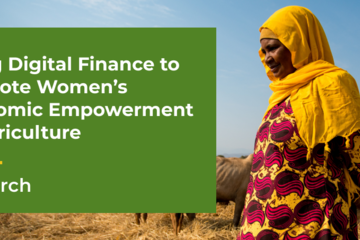
Using Digital Finance to Promote Women’s Economic Empowerment in AgricultureDigital financial services have the potential to positively affect women’s economic empowerment, despite limitations that restrict their access to and use of financial resources and services. Building on the Digital Finance and Women’s Economic Empowerment in Beyond Production Roles in Agriculture and Food Systems report published by the Feed the Future Advancing Women’s Empowerment Program, this webinar will invite participants to learn about promoting women’s economic empowerment in agriculture using digital financial services. Presenters will share out the findings, conclusions, and recommendations from the report, highlighting through a fireside chat the lessons learned and best practices from implementers and service providers working in the DFS space, and provide time for participants to pose questions to the presenters. To learn more/Register: Using Digital Finance to Promote Women’s Economic Empowerment in Agriculture | AgrilinksBy: Raquel AcostaMonday, Mar 28, 2022AGRI-FOOD SYSTEMS
-
Young African Landscape Leadership ProgramDo you have a demonstrated commitment to advancing sustainability for Africa’s landscapes, seascapes and communities?Do you want to be part of a global community of friends working to promote sustainable and equitable land management through the landscapes approach?Are you between 18 and 35 years old?The Global Landscapes Forum (GLF), in partnership with the Youth in Landscapes Initiative (YIL), is launching the first ever “Young African Landscape Leadership” program, an 8-months program filled with networking meetings, regional dialogues, workshops and more.Let us know who you are, and your motivation to join. With a median age of just 19.7 years, Africa’s diverse population is by far the youngest of any other continent in the world. These unique demographics offer a significant advantage in the drive to revive ecosystems and safeguard livelihoods. Africa’s youth have immense potential to forge a new development model and vision for the continent as they are already champions for landscape action and community-based solutions. The GLF, in partnership with the Youth in Landscapes Initiative, is launching the first ever Young African Landscape Leadership, an eight-month annual program filled with networking meetings, regional dialogues, workshops and much more. Learn more/apply: Young African Landscape Leadership 2022 - Youth in Landscapes Initiative (globallandscapesforum.org)By: Raquel AcostaWednesday, Mar 16, 2022CULTURE AND SOCIETY+1
No Preview Available -
Young African Leaders ProgrammeThe Young African Leadership Programme funded by the European Commission is a tailor-made fellowship and training programme aiming at catalysing and fostering changes as envisioned in the Africa Agenda 2063 and in the Africa-EU Partnership. After a pilot cohort in Autumn 2021, the second cohort of Young African Leaders is expected in Florence in September 2022 The Young African Leaders Programme is a fellowship scheme that provides a unique opportunity for policy experts from Africa (all regions) to further develop their policy work and professional and leadership skills amidst international experts. Furthermore, the Programme aims at creating new networks, connecting a strong cohort of leaders committed to driving change in their own countries and across the continent, as well as address the gender gaps and foster inclusivity in leadership roles. In the dynamic academic environment of the European University Institute (EUI) in Florence, selected participants will take part in workshops, training and skills development sessions, conferences, and study visits in Europe. Interaction with the other fellows, policymakers and the academic community at the EUI will make this a truly unforgettable experience. The structure of the Programme will be as follows: Executive Training Seminars on thematic issues; Professional Development Workshops, providing a set of leadership skills, tools and concrete case studies; Study Visits to EU institutions, relevant academia, and international organisations Final individual written assignment Award of the YALP certificate of attendance Connection to network of scholars and practitioners knowledgeable in relevant transnational governance The three-month leadership programme takes place from the 1 September 2022 to the 30 November 2022. Fellowships are fully-funded with a grant of € 2,500 per month. The selected African fellows must live in the area of Florence for the duration of their stay. The language of the Programme is English. Where possible, the STG will seek to integrate French. The Programme has an intensive training schedule, and is therefore a full-time and fully-funded fellowship scheme. Who should apply? The Programme targets mid-career, high potential policy-makers, diplomats, and professionals from Africa, working in national and local authorities, regional, continental, international organisations and development partners, civil society organisations, academia, media and private sector, in Africa. More precisely, the Programme is open to professionals (M/F/X), mid-career and executives alike, who are nationals of African countries, residing in Africa and are up to the age of 35. This Programme is supported by the European Commission, Directorate-General for International Partnerships. This Call for applications is launched under a suspension clause, related to the final approval of the financing decision of the Programme by the European Commission. According to such clause, should not the financing decision be taken, the EUI/STG reserve the right to cancel the call without any prejudice to the Institute and potential beneficiaries. This programme is supported by the Directorate-General for International Partnerships of the European Commission. For enquiries about applications please vist: Young African Leaders Programme • European University Institute (eui.eu) Or contact: apply.fellowships.stg@eui.euBy: Raquel AcostaWednesday, Mar 16, 2022CULTURE AND SOCIETY+1
 No Preview Available
 -
UNESCO Prize for Girls’ and Women’s EducationThe 2022 Call for Nominations is open until 20 May Gender equality in education is a basic right and a prerequisite to build inclusive societies. Although notable progress has been made over the last 20 years, the ongoing COVID-19 pandemic has caused unprecedented disruption to education and exacerbated existing inequalities, disproportionately affecting girls and women. Today, 127 million girls of primary and secondary school age are out of school, three quarters of children who may never set foot in school are girls while women still accounted for almost two-thirds of all adults unable to read in 2019. (UNESCO Institute for Statistics). The UNESCO Prize for Girls’ and Women’s Education honours outstanding and innovative contributions made by individuals, institutions, and organizations to advance girls’ and women’s education. It is the first UNESCO Prize of this nature and is unique in showcasing successful projects that improve and promote the educational prospects of girls and women and in turn, the quality of their lives. Funded by the Government of the People’s Republic of China, the Prize is conferred annually to two laureates and consists of an award of US $50,000 each to help further their work in the area of girls’ and women’s education. The Director-General of UNESCO awarded the Prize for the first time in 2016. Established by UNESCO’s Executive Board, the Prize directly contributes to the attainment of the 2030 Sustainable Development agenda, particularly SDG 4 on education and 5 on gender equality. It also supports UNESCO’s global priorities included in the Medium-term Strategy 2022-2029 and the Gender Equality Action Plan 2014-2021 (GEAP II), as well as the UNESCO strategy for gender equality in and through education (2019-2025).By: Raquel AcostaWednesday, Mar 16, 2022CULTURE AND SOCIETY
No Preview Available -
Call for Proposals for Research Teams for Women RISEResearch Teams are invited to submit Concept Notes for two-year research projects. Teams successful at the Concept Note stage will be invited to submit Full Proposals. The following types of research are considered in scope: Epidemiological studies that describe and analyze patterns of diseases or health among women and consider different population and occupational factors. Population health research that explores diverse women’s experiences as individuals and within the society (e.g., family and community, intergenerational relationships, socioeconomic groups, work groups and enterprises). Intervention and Implementation research focused on exploring how policies, practices and strategies already put in place to alleviate the impact of COVID-19 influence the relationships between women’s paid and unpaid work and their health. Specific Research Areas A subset of funds is available to support research that is relevant to the scope and objectives of Women RISE and specifically addresses one of the following three Specific Research Areas: Infectious diseases research focused on understanding how relationships between women’s work and health have been shaped by and are shaping disruptions to infectious disease prevention, immunization programs and care services. HIV/AIDS STBBI research specific to women living with HIV/AIDS, COVID-19-related disruptions to HIV and STBBI prevention or care services, or the health of women in occupations that put them at increased risk for HIV and STBBI acquisition. Pandemics and other health emergencies research that investigates ways the COVID-19 experience can inform, improve, and safeguard women’s health and socioeconomic well-being against future health emergencies. Eligibility The Research Team must include a Principal Investigator (PI) who is a low- and middle-income country (LMIC) researcher based in the LMIC Lead Applicant Organization and residing in an eligible LMIC country/territory where the research is proposed. The PI will be the team lead and will work in close collaboration with a Canada-based Co-Principal Investigator (Co-PI) and a Decision-Maker Co-PI based in the same country as the Lead Applicant Organization or in a country where the research will take place. For applications involving Indigenous communities, the RT must include at least one member who self-identifies as Indigenous or provides evidence of having meaningful and culturally safe involvement with Indigenous Peoples in an Indigenous Health Research Environment. The Research Team must also include a Lead Applicant Organization and a Canadian Co-Applicant Organization. More details For more information, please read the detailed call for concept notes. Please also consult our frequently asked questions.By: Raquel AcostaWednesday, Mar 16, 2022CULTURE AND SOCIETY+1
No Preview Available -
Volunteer Internship Opportunities in TanzaniaTwo organizations are looking for interns with good writing skills, in Dar es Salaam and Arusha, Tanzania. Both can provide secure and well-appointed housing for the volunteer, but other expenses (food, transport, visa) will have to be covered by the volunteer. Both would be good opportunities for graduate students with an interest in East Africa to meet people and become part of a community. Swahili proficiency is not needed, but some familiarity with Swahili would be valuable for a good experience. Mkuki na Nyota Publishers is Tanzania's most prestigious publisher and the volunteer will work under the direction of the owner and director, Walter Bgoya, one of Tanzania's elder statesmen of letters. The intern will be involved in all aspects of publishing depending on expertise, but mainly marketing and copyediting in English. The volunteer would be provided with a safe and well-appointed apartment in downtown Dar es Salaam near the Mkuku na Nyota office. Interested candidates should contact Walter Bgoya by email. Pamoja Tuwalee grows out World Education Inc. (WEI) and continues to implement projects in education and care for orphans and vulnerable children. The volunteer would work with Lilian Badi, who has worked with WEI and its associated programs for over a decade. The volunteer would work primarily on proposal writing. The volunteer would be provided with a safe and well-appointed apartment near the Pamoja Tuwalee office. Interested candidates should contact Lillian Badi by email. For more questions you can also reach out to Paul Bjerk at Texas Tech UniversityBy: Raquel AcostaWednesday, Mar 16, 2022CULTURE AND SOCIETY
No Preview Available

Leave a comment