

Browse
African Futures Cohort 5 Arrives On Campus
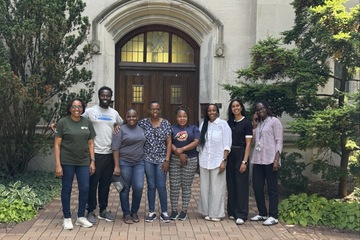
Alliance for African Partnership (AAP), a consortium of ten leading African universities, Michigan State University (MSU), and a network of African research institutes, is excited to welcome the fifth cohort of the African Futures Research Leadership Program to MSU for the in-person portion of the program. Each early career scholar is paired with a faculty mentor from MSU and their home institution for one year of virtual and in-person collaboration to strengthen research skills, innovations in teaching, writing of scholarly and/or policy publications, dissemination of research results and grant proposals.
A consortium-wide initiative, the African Futures program is designed to strengthen the capacity of a cadre of African researchers to return to their home institutions and become scientific leaders in their community, establish long-term partnerships with MSU faculty, co-create innovative solutions to Africa’s challenges, and in turn become trainers of the next generation of researchers.
African Futures Cohort 5: Alfdaniels Mabingo Performing Arts and Film Makerere University Home Mentor - Sylvia Antonia Nakimera Nannyonga-Tamusuza, Dept of Performing Arts and FilmMSU Mentor – Philip Effiong, Dept of English, Theater Studies & Humanities & Gianina Strother, Dept of African American and African Studies Gladys Gakenia Njoroge Pharmacy Practice and Public Health United States International University – Africa Home Mentor - Calvin A. Omolo, Dept of Pharmacy Practice and Public HealthMSU Mentor - Yuehua Cui, Dept of Statistics and Probability Seynabou Sene Plant Biology University Cheikh Anna Diop Home Mentor - Abdala Gamby Diedhiou, Dept of Plan BiologyMSU Mentor - Lisa Tiemann, Dept of Plant, Soil, and Microbial Sciences Portia T. Loeto Educational Foundations (Gender Studies Section) University of Botswana Home Mentor - Godi Mookode, Dept of SociologyMSU Mentor - Soma Chauduri, Dept of Sociology Betina Lukwambe Aquaculture Technology University of Dar es Salaam Home Mentor – Samwel Mchele Limbu, Dept of AquacultureMSU Mentor - Abigail Bennett, Dept of Fisheries and Wildlife & Maria Claudia Lopez, Dept of Community Sustainability Assilah Agigi Business Management University of PretoriaHome Mentor - Alex Antonites, Dept of Business Management MSU Mentor - Sriram Narayanan, Dept of Supply Chain Management Miriam Nthenya Kyule Agricultural Education and Extension Egerton University Home Mentor - Miriam Karwitha Charimbu, Dept of Crops, Horticulture and Soils MSU Mentor - Susan Wyche, Dept of Media and Information Studies Asha Nalunga Agribusiness and Natural Resource Economics Makerere University Home Mentor - Bernard Bashaasha, Dept of Agribusiness and Natural Resource Economics MSU Mentor - Saweda Liverpool-Tasie, Dept of Agricultural, Food, and Resource Economics
Ezinne Ezepue (participating virtually)Theatre & Film Studies University of Nigeria, Nsukka Home Mentor - Chinenye Amonyeze, Dept of Theatre & Film StudiesMSU Mentor - Jeff Wray, Dept of English
“We were extremely impressed with the quality and diversity of applications we received for this cohort of the African Futures program. We are excited to build on the successes of past cohorts and continue to evolve this program as we support the next generation of African research leaders,” said Jose Jackson-Malete, co-director of the Alliance for African Partnership.
Differing from previous cohorts, Cohort 5 is piloting a hybrid model of the African Futures program. The scholars began their work in February 2025 virtually, then will spend the fall semester at Michigan State University working closely with their MSU mentor. They will then complete the rest of their year back at their home institution, culminating in a research showcase in February 2026 to share the research they’ve done. Partnerships between mentors and mentees are expected to continue beyond the end of the program and lead to sustainable collaboration and future funding opportunities.
By:
Baboki Gaolaolwe-Major
Wednesday, Sep 17, 2025
EDUCATION
Leave a comment
Engineering a Sustainable Future Through Climate-Smart Agriculture
A profile of MSU Assistant Professor and AAP GEF Awardee, Dr. Daniel Uyeh
Science and technology are central to tackling global challenges like climate change and food insecurity. In June 2025, the Alliance for African Partnership (AAP) launched the Faculty Global Engagement Fund (GEF) to help faculty maintain momentum in their research endeavors and international collaborations by providing travel support to engage with African partner institutions and/or to present their research at conferences or other public forums. Among the inaugural GEF cohort is MSU faculty member Dr. Daniel Uyeh, a Nigerian scientist and engineer whose work integrates advanced sensors, automated weather stations, and AI-enabled decision-support systems to turn real-time climate data into actionable guidance for farmers and policymakers—strengthening food security and resilience across the continent.
Born and raised in Nigeria, Dr. Uyeh spent most of his childhood in rural neighborhoods. There he witnessed firsthand how the practice of farming and knowledge of agriculture shaped community livelihoods. He also witnessed the work of his father, a vocational teacher who taught agriculture to the community to better improve their farming capabilities. Inspired by his father’s role as a teacher and his experience in farming communities, Uyeh focused his academic career on agriculture. From his internships in biotechnology and pharmaceuticals to his Bachelors, Masters, and PhD degrees, he has been studying the field of agriculture for over a decade. Currently, he is working as both assistant professor in the Department of Biosystems and Agricultural Engineering as well as a principal investigator in the Climate-Smart Decision Support Systems Group of MSU. He is a Nigerian scientist and engineer who, in his own words works on “multidisciplinary research projects towards improving efficiency and minimizing production costs, thus ensuring resilient and sustainable agriculture”.
His resume is impressively extensive and his most recent project, which he highlighted during the application for GEF support, continues to show his dedication and experience in the field of agricultural research.
This project focuses on the development and deployment of automated weather stations and other advanced sensory technologies, calibrated to an integrated decision support system (DSS). The DSS will translate real time climate data into actional insights for farmers and policy makers, allowing timely informed decisions on critical aspects of farming and agriculture. By stabilizing food supplies in the face of erratic weather, this work has the potential to deliver immediate, measurable impact for communities across Sub-Saharan Africa.
Uyeh and his team have already developed and piloted an integrated platform that provides real-time, weather and advisory services for farmers, allowing them to better prepare for the challenges facing their farms and livestock. In the future he intends to expand the deployment of automated weather sensory technology as well as the DSS system across the entirety of Africa, doing so through further partnerships with African government agencies, many of whom are already investing in adaptation and agricultural digitization. In Uyeh’s words: “The end goal of my research is to create AI-enabled, climate-smart tools that make agriculture more resilient, sustainable, and profitable. My work aims to provide farmers, especially smallholders, women, and youth, with reliable, hyperlocal decision-support systems that help them adapt to climate change, reduce input costs, and improve yields. At the same time, I aim to support breeders and policymakers with enhanced data to inform varietal development, resource utilization, and climate adaptation strategies. Ultimately, my vision is to contribute to transforming agriculture from a system vulnerable to erratic weather and labor shortages into one that is data-driven, low-emission, and sustainable, securing food systems and livelihoods for millions worldwide.”
In our interview for this article, Uyeh was asked what he would say to future researchers inspired by his example—just as he was by his father. His advice: “Research is about exploring the unknown, asking questions others may overlook, and learning from every setback. Stay curious, stay resilient, and view failures not as dead ends but as stepping stones toward discovery and impact.”
By:
Baboki Gaolaolwe-Major
Wednesday, Sep 17, 2025
EDUCATION
+1

Leave a comment
African Futures Cohort 5 Arrives at MSU
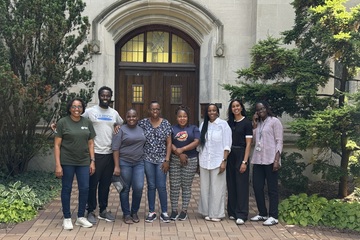
Alliance for African Partnership (AAP), a consortium of ten leading African universities, Michigan State University (MSU), and a network of African research institutes, is excited to welcome the fifth cohort of the African Futures Research Leadership Program to MSU for the in-person portion of the program. Each early career scholar is paired with a faculty mentor from MSU and their home institution for one year of virtual and in-person collaboration to strengthen research skills, innovations in teaching, writing of scholarly and/or policy publications, dissemination of research results and grant proposals.
A consortium-wide initiative, the African Futures program is designed to strengthen the capacity of a cadre of African researchers to return to their home institutions and become scientific leaders in their community, establish long-term partnerships with MSU faculty, co-create innovative solutions to Africa’s challenges, and in turn become trainers of the next generation of researchers.
African Futures Cohort 5: Alfdaniels Mabingo Performing Arts and Film Makerere University Home Mentor - Sylvia Antonia Nakimera Nannyonga-Tamusuza, Dept of Performing Arts and FilmMSU Mentor – Philip Effiong, Dept of English, Theater Studies & Humanities & Gianina Strother, Dept of African American and African Studies Gladys Gakenia Njoroge Pharmacy Practice and Public Health United States International University – Africa Home Mentor - Calvin A. Omolo, Dept of Pharmacy Practice and Public HealthMSU Mentor - Yuehua Cui, Dept of Statistics and Probability Seynabou Sene Plant Biology University Cheikh Anna Diop Home Mentor - Abdala Gamby Diedhiou, Dept of Plan BiologyMSU Mentor - Lisa Tiemann, Dept of Plant, Soil, and Microbial Sciences Portia T. Loeto Educational Foundations (Gender Studies Section) University of Botswana Home Mentor - Godi Mookode, Dept of SociologyMSU Mentor - Soma Chauduri, Dept of Sociology Betina Lukwambe Aquaculture Technology University of Dar es Salaam Home Mentor – Samwel Mchele Limbu, Dept of AquacultureMSU Mentor - Abigail Bennett, Dept of Fisheries and Wildlife & Maria Claudia Lopez, Dept of Community Sustainability Assilah Agigi Business Management University of PretoriaHome Mentor - Alex Antonites, Dept of Business Management MSU Mentor - Sriram Narayanan, Dept of Supply Chain Management Miriam Nthenya Kyule Agricultural Education and Extension Egerton University Home Mentor - Miriam Karwitha Charimbu, Dept of Crops, Horticulture and Soils MSU Mentor - Susan Wyche, Dept of Media and Information Studies Asha Nalunga Agribusiness and Natural Resource Economics Makerere University Home Mentor - Bernard Bashaasha, Dept of Agribusiness and Natural Resource Economics MSU Mentor - Saweda Liverpool-Tasie, Dept of Agricultural, Food, and Resource Economics
Ezinne Ezepue (participating virtually)Theatre & Film Studies University of Nigeria, Nsukka Home Mentor - Chinenye Amonyeze, Dept of Theatre & Film StudiesMSU Mentor - Jeff Wray, Dept of English
“We were extremely impressed with the quality and diversity of applications we received for this cohort of the African Futures program. We are excited to build on the successes of past cohorts and continue to evolve this program as we support the next generation of African research leaders,” said Jose Jackson-Malete, co-director of the Alliance for African Partnership.
Differing from previous cohorts, Cohort 5 is piloting a hybrid model of the African Futures program. The scholars began their work in February 2025 virtually, then will spend the fall semester at Michigan State University working closely with their MSU mentor. They will then complete the rest of their year back at their home institution, culminating in a research showcase in February 2026 to share the research they’ve done. Partnerships between mentors and mentees are expected to continue beyond the end of the program and lead to sustainable collaboration and future funding opportunities.
For more information, visit the Alliance for African Partnership website
By:
Justin Rabineau
Thursday, Sep 4, 2025
AGRI-FOOD SYSTEMS
+6
Leave a comment
100,000 PhDs in 10 Years? Africa Needs More Than Numbers—We Need a Doctoral Revolution
Across Africa, the demand for knowledge has never been greater. From climate change to health systems, digital transformation to food security, the continent faces a web of complex, intersecting challenges. Yet paradoxically, while the urgency for African-led solutions intensifies, our universities struggle to produce the kind of advanced, homegrown expertise needed to drive sustainable development.
At the core of this dilemma is a systemic underproduction and underutilization of PhDs.
Africa contributes less than 2% of global research output, and many of its universities remain under-resourced, underfunded, and overly dependent on external collaborators. Doctoral education, supposed to be an engine of innovation, leadership, and knowledge production, suffers from fragile infrastructure, limited mentorship capacity, brain drain, and misaligned curricula.
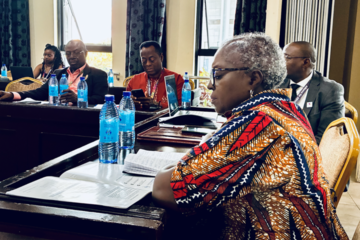
It’s within this context that the Alliance for African Partnership (AAP) convened a number of timely and ambitious discussions over the past six months including a panel at the Paul Zeleza Conference at Howard University in May and a workshop during AAP’s annual consortium meeting held recently in Lilongwe, Malawi. The focus? A bold target set by the African Union: 100,000 PhDs in 10 years. This would require training scholars already in the system to PhD level and attracting new students into the system. But these conversations went far beyond the numbers, they were about the transformation of Africa’s doctoral education systems needed to achieve this goal.
Beyond Numbers: Rebuilding the Ecosystem
Speaking on a panel at a Howard University conference celebrating the 70th birthday of Prof. Paul Tiayambe Zeleza, Prof. Tawana Kupe called for wholesale systemic change in African graduate education, from application to graduation. Prof. Kupe is currently a higher education strategy advisor and former vice chancellor of the University of Pretoria. He emphasized the need to institute accountability mechanisms at every stage, to increase supervision capacity by having more PhD holders in universities’ faculty, to invest in infrastructure and space, and to changing from research only to coursework and sandwich doctorate structures.
At the AAP meeting in Lilongwe, Prof. Alex Kahi, AAP focal point at Egerton University, said, “To achieve this, we need a multifaceted approach. It’s not just about enrolling more students. We must reimagine the entire doctoral ecosystem, invest in funding, strengthen institutional capacity, reform curricula to solve real-world problems, and build administrative systems that support scholars from entry to postdoc.”
The discussion acknowledged that training a PhD is costly, averaging about $70,000 per year, or $350,000 across a five-year period. But more than just cost, it is also about value: What kind of researcher are we producing? Are they equipped to thrive in the job market, drive policy change, lead enterprises, or create new industries in Africa’s context?
“We need both quality and quantity,” emphasized Prof. Titus Awokuse. “But we also need relevance. At the moment, we’re not preparing enough PhDs to meet the needs of African societies and economies.”
Challenging the System: Gatekeepers, Mentors, and the Missing Middle
These discussions also shone a light on an uncomfortable but necessary issue: gatekeeping in academia. Many doctoral systems are dominated by senior academics or institutional norms that resist change, clinging to outdated methodologies, top-down supervision models, and narrow definitions of scholarly success.
At the Lilongwe meeting, Awokuse raised a crucial question: “How do we engage the gatekeepers who control access to doctoral spaces, resources, and networks?” Without disrupting this status quo, true reform may remain out of reach. For Dr. Linley Chiwona-Karltun, the solution lies partly in designing doctoral experiences around real-world relevance and global-local balance. “We need PhDs who have seen both worlds, those who spend time in the Global North and in Africa, gaining skills and perspectives that make their research meaningful on both fronts. To achieve that, we need meaningful and well-designed partnerships that will enable relevant mentorship and sharing of resources”
At the Zeleza conference panel, Prof. Kupe highlighted the crisis around PhD supervision. “Why do we recruit students even where we do not have the capacity to train or supervise, then make the students wander around looking for a supervisor?” He went on to contend that, “the one-supervisor model is terrible, especially when the supervisor is part of the majority sea of mediocrity that is so common in our public life, but can be good when the person is part of the minority oasis of hope, which is not very common.”
Decolonizing the PhD: Shifting Power, Reclaiming Voice
Several of the speakers at both events raised the need for collaboration among institutions and across global regions. At the Zeleza conference, AAP Makerere focal point Robert Wamala argued that, “universities could overcome some of their problems by investing in things like virtual laboratories, virtual research platforms and joint degree programmes.” AAP Co-Director, Amy Jamison suggested that joint supervision models involving north-south partnerships could alleviate the supervisor shortage crisis.
But it’s not just about collaboration, it’s also about reclaiming autonomy. “We need a paradigm shift,” said Dr. Dorothy Ngila, Deputy Chair of the AAP advisory board, at the Lilongwe meeting. “A shift that recognizes that African PhDs cannot simply replicate Euro-American models of knowledge. They must reflect African priorities, indigenous knowledges, and local contexts.” In this sense, decolonizing doctoral education is not just an ideological demand, it is a strategic necessity. It calls for a redesign of curricula, methodologies, and evaluation systems to empower scholars to ask the right questions and produce research that is impactful, contextually relevant, and globally respected.
At the Zeleza conference, Howard University’s Provost Prof. Anthony Wutoh applied this idea to AI as an emerging technology impacting graduate education globally. “Universities need to make use of artificial intelligence [AI] as a tool for supporting PhD training. Generative AI provides us with opportunities to rearrange the way we train doctorates, and we should leverage this.” He argued that since 90% of AI content is Eurocentric, Africans need to develop algorithms and content relevant to the African continent.
A Future of Questions, And Opportunity
Both events closed with a powerful sense of urgency, but also of possibility. And while consensus formed around several ideas, it was the questions that lingered most powerfully:
How do we retain African PhDs after we train them? Too many are lost to the Global North due to limited research funding, institutional instability, or lack of career opportunities. Can we create incentives, financial, academic, and emotional, that make African universities vibrant homes for doctoral talent and ecosystems that will enable them to thrive?
How do we embed curiosity, entrepreneurship, and leadership into doctoral pathways? PhDs should not just be technical experts, they must be problem-solvers, innovators, and systems thinkers. How do we build doctoral programmes that nurture imagination, risk-taking, and real-world impact?
How can small grants and local funding models empower the next generation of scholars? Large international funders often dominate the research agenda. Can we develop agile, African-led microgrant schemes to support emerging researchers with bold ideas and community-grounded questions?
What does it really mean to decolonize the PhD? Beyond slogans, what does it look like to change the very DNA of Africa’s doctoral systems, in who teaches, what is taught, how research is validated, and whose voices are centered?
Final Thoughts: The Doctoral Dream Must Be a Collective One
The vision of producing 100,000 PhDs in 10 years is not out of reach. But it will not happen by scaling up what already exists. It will require a deep and honest reckoning with the structures, cultures, and ideologies that shape how we train scholars in Africa. If anything, the workshop in Lilongwe was a clarion call, not just to increase PhD numbers, but to transform what a PhD means for Africa’s future.
The path ahead demands courage, collaboration, and creativity. But most of all, it demands that we ask, and keep asking, the right questions.
By:
Baboki Gaolaolwe-Major
Tuesday, Jul 15, 2025
EDUCATION
Leave a comment
Co-Creating Feasible and Sustainable Play-based Learning: A 2024 PIRA Award Winning Initiative
Every year, the Alliance for African Partnership (AAP) runs an initiative known as the Partnerships for Innovative Research in Africa (PIRA). It is an opportunity for researchers to earn the funding needed to carry out collaborative, supportive and multidirectional projects which are aimed towards improving Africa. The research ideas put forward by each PIRA awardee have shown the potential to change the future of Africa for the better.
The project created by Dr. Bethany Wilinski of Michigan State University (MSU) and Dr. Subilaga M Kejo of the University of Dar es Salaam (UDSM) is no exception. Collaborating, they are researching “Co-Creating Feasible and Sustainable Play-based Learning Approaches in Tanzania”. Based on a decade of collaboration in research into teaching in Tanzania, they have understood that play based teaching is essential for development of the global youth. It allows children to exercise skills across all academic areas, while developing them within authentic contexts, which in turn develops an enthusiasm for young students to continue learning more advanced subjects.
Play based learning has been acknowledged on a global scale, especially so once the United Nations Convention on the Rights of the Child recognized that this approach to learning will support countries’ progress toward achieving Sustainable Development Goal (SDG) 4: quality education for all. Be that as it may, while on paper it has proven to be the superior teaching model, some countries have been unable to put this into practice, such as Tanzania. Cultural differences, time and staff restraints, and even ignorance to it’s benefits, have stopped this learning style from being used in Tanzanian classrooms.
That is why the aim of Dr. Bethany Wisinki and Dr. Subilaga M Kejo’s project is to “transform pre-primary teaching and learning in Tanzania by supporting teachers’ ability to use play-based approaches effectively.” Their project consists of a three-phase plan:
1: Building a community of practice (CoP) using pre-primary teachers of UDSM’s demonstration schools, university faculty, teacher development experts and more to create a shared understanding of play based learning.
2: Together they will experiment, test and develop a professional development (PD) program about play-based for Tanzanian pre-primary teachers.
3: Pilot the PD with pre-primary teachers in Dar es Salaam and Musoma
As of this article, the team have made promising headway into phase one of their project. 7 modules have been developed, and the teachers of the CoP have already completed 6. The feedback has been positive, with the teachers stating that “they find the training to be beneficial especially because of the modality where they have opportunity to read, practice, reflect and discuss about their experiences which has enhanced their understanding…Generally, the teachers see the benefits of play and seem more motivated and confident to use play-based learning approach.”
There are already plans in place to move phase two of the project on schedule, and both Dr. Bethany Wisinki and Dr. Subilaga M Kejo feels that their work will leave a positive impact on Tanzania’s teaching methods and youth moving forward.
Upon the project’s completion, they plan to use their findings “to inform the development of a research-practice partnership with the Tanzania Institute of Education focused on improving the quality of preservice preparation for pre-primary teachers.”
By:
Baboki Gaolaolwe-Major
Tuesday, Jul 15, 2025
YOUTH EMPOWERMENT
+1
Leave a comment
The Business of Water: A COIL Project By AAP
Collaborative Online International Learning (COIL) is a method of education which fosters intercultural learning and development through shared values, presented perspectives, and mutual understanding despite geographical and cultural barriers. It connects students and professors in different countries for collaborative projects and discussions carried out virtually as part of their coursework. As an educational innovation, it reflects the values and goals of the Alliance for African Partnership (AAP) to foster mutually beneficial programs which catalyze lasting partnerships among our consortium members, which is why AAP launched the COIL Faculty Fellows Program-Africa in 2023. Since 2023, AAP along with Michigan State University’s (MSU) Global Youth Advancement Network have supported 14 teams of faculty to design and implement COIL projects.
The highly successful“The Business of Water” COIL project implemented by faculty from MSU and the University of Nigeria Nsukka is a great example of the type of impact COIL can have on both faculty members and students The project comprised 30 students from UNN and MSU, and led by Antoinette Tessmer OF THE Broad College of Business (Finance Dept.), Michigan State University and Nkadi Onyegegbu, Faculty of Education (Science Education Dept.), University of Nigeria Nsukka (Nigeria). It’s aim was to teach students the factors and events that control “The Business of Water” both in their universities and in their communities. UNN and MSU students communicated through online methods such as Zoom or WhatsApp, and they collected data through site visits and interviews among other methods.
Over the course of six weeks, the students learned the intricacies of specific water-based businesses, such as the drinking water industry and the water recycling industry, using the Environmental Social Governance (ESD) framework to structure their research and to later propose a call to action based upon their findings.
By the end of the COIL project, the students and facilitators had engaged and collaborated to such a degree that contacts, bonds and partnerships were formed, breaking through the cultural and international barriers. When giving their experiences on the project, some students wrote the following:
“At the end of the day, we pushed others in new ways of understanding and collaboration that will impact us after we graduate”
“This was my first experience collaborating with international students overseas and I can gladly say that COIL was the online tool that made it possible”
“This experience has highlighted mutual respect and honesty, allowing us to work together on relevant and environmentally sustainable solutions...I feel more equipped to contribute to global discussions”
“These problems also taught me how to communicate with people from different cultures and helped grow my interpersonal skills”
By the metric of engaging students in the “Business of Water” as well as forming intercultural bonds, the AAP has deemed this COIL project another success, among many, and is excited to champion more COIL projects to come.
By:
Baboki Gaolaolwe-Major
Wednesday, Jul 23, 2025
YOUTH EMPOWERMENT
+1
Leave a comment
Celebrating a Legacy of Vision, Dedication, and Continental Impact
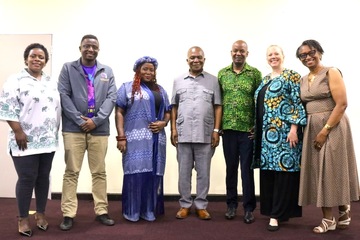
We take this opportunity to honour one of our most visionary leaders, Professor Richard Mkandawire, who retires after years of exceptional service as the Director of the AAP Africa Office, as the Alliance for African Partnership (AAP) continues to grow in strength and purpose. The experience Professor Mkandawire has had with AAP has been nothing short of revolutionary. Richard was a well-known development expert and supporter of soil health who approached his work with insight, moral character, and endless enthusiasm. AAP has become a reliable forum for cooperative research, policy engagement, and capacity building as a result of his dedication to cultivating partnerships throughout Africa. He oversaw the expansion of the AAP throughout African institutions, fostering connections between policy, academia, and the public. From empowering young researchers to advocating for agricultural reform and ensuring soil health remained a top priority for food security on the continent, Richard's enthusiasm for Africa's prosperity was evident in every project he supported. Partners, mentees, and colleagues from around the world gathered at his farewell dinner, held on the last night of the AAP Consortium Meeting 2025 in Lilongwe, Malawi, to honor a man whose work has left a legacy. He was described as a leader, a mentor, and most importantly, a true servant of Africa, in the flood of tributes that poured in. Richard Mkandawire, AAP honors you. Your legacy will continue to inspire, your vision will keep guiding us, and your influence on the lives you have impacted and the organizations you have influenced will only grow. Richard, thank you. We wish you a peaceful, happy, and well-earned retirement.
By:
Baboki Gaolaolwe-Major
Thursday, Jul 10, 2025
AGRI-FOOD SYSTEMS
+2
Leave a comment
Higher Education, Geopolitics, and Sustainable Development in Africa
Amid shifting geopolitical and policy landscapes in the U.S., uncertainties have emerged that may impact global education and research collaborations. While the full implications of these changes remain unclear, higher education institutions must remain steadfast in their mission to promote knowledge, collaboration, and sustainable development.
Alliance for African Partnership (AAP) in collaboration with the African Studies Center, Michigan State University are pleased to invite you to the AAP Public Dialogue on Higher Education, Geopolitics, and Sustainable Development in Africa. Join us as our expert panel discuss the contributions of African higher education institutions in transformative research, policy shaping, crisis leadership, and actionable strategies for strengthening the higher education sector amid these uncertainties, while advancing the 2030 Agenda for Sustainable Development.
Panelists:
Tawana Kupe – Visiting Research Scholar, Michigan State University
Amalia Uamusse – Deputy Vice Chancellor, Eduardo Mondlane University
David Norris – Vice Chancellor, University of Botswana
Mwenda Ntarangwi – Vice Chancellor, USIU-Africa
By:
Justin Rabineau
Wednesday, Mar 12, 2025
EDUCATION
Leave a comment
Breaking Barriers: Sexual and Gender Minority-Led Advocacy to End AIDS in Africa and The Caribbean
Breaking Barriers provides readers a rare window into the realities of LGBT activism in Africa and the Caribbean. Close examinations of the ways in which LGBT-led activist organizations in Africa and the Caribbean contribute to progress in addressing the HIV epidemic in the face of immense and varied challenges are too rare. This book changes that dynamic by following these activists' journey to success under difficult circumstances. Readers will learn what it takes for local activists to eliminate obstacles to HIV prevention and care in their communities.
By:
Robin Lin Miller
Monday, Feb 17, 2025
HEALTH AND NUTRITION

Leave a comment
AAP announces 8 new PIRA partnership awards
Alliance for African Partnership (AAP), a consortium of ten leading African universities, Michigan State University (MSU), and a network of African research institutes, is excited to announce the recipients of the 2024 Partnerships for Innovative Research in Africa (PIRA) seed funding. Each team is composed of at least one lead from an AAP African member institution and one MSU lead. Some teams also include additional partners from NGOs and/or other universities from outside of AAP’s consortium. A consortium-wide initiative, PIRA grants are a tiered funding opportunity designed to cultivate and support multidirectional and transregional research partnerships at any stage of their development, whether it be initiatives to explore and create new relationships or scale existing ones. The total amount of PIRA grants awarded in 2024 is over $500,000.
Awarded projects cover diverse disciplinary perspectives and span AAP’s seven priority areas:
Agri-food systems
Water, Energy and Environment
Culture and Society
Youth Empowerment
Education
Health and Nutrition
Science, Technology and Innovation
All projects will integrate gender, equityand and inclusion issues in all stages of the project.
This year’s winning projects include:
Towards the Implementation of Smart Villages in the Rural Communities of Taraba State in Nigeria
Research leads: Shanelle N. Foster (MSU), Chidimma Frances Igboeli (University of Nigeria, Nsukka), Mbika Mutega (University of Johannesburg), Sari Stark (University of Lapland)
Institutional partners: Michigan State University (College of Engineering), University of Nigeria, Nsukka, University of Johannesburg and University of Lapland
Funding tier: Scaling grant (up to $100,000)
Green Technology Extraction and Characterization of Bioactive Components from Edible Fruits of Vitex donania and Uvaria chamae
Research leads: Leslie D. Bourquin (MSU), Insa Seck (UCAD)
Institutional partners: Michigan State University (College of Agriculture & Natural Resources), Universite Cheikh Anta Diop
Funding tier: Planning grant (up to $50,000)
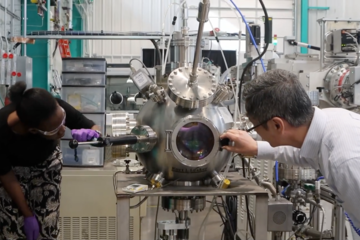
Qi Hua Fan of MSU (left) and Tabitha Amollo of Egerton University (right) working in their solar cell lab.
Develop a Partnership for Renewable Energy Research and Education
Research leads: Qi Hua Fan (MSU), Tabitha Amollo (Egerton)
Institutional partners: Michigan State University (College of Engineering), Egerton University
Funding tier: Scaling grant (up to $100,000)
Bridging the Gap: Strengthening Research, Management and Community Alliances in South Africa’s Largest Coastal Marine Protected Area
Research leads: Amber K. Peters (MSU), Els Vermeulen (UP), Grant Smith (Sharklife)
Institutional partners: Michigan State University (College of Agriculture and Natural Resources), University of Pretoria, Sharklife Conservation Group
Funding tier: Planning grant (up to $50,000)
Changing Public Attitudes and Behaviors of Buying Counterfeits through Evidence-Based Education and Awareness-Raising Campaigns in Kenya
Research leads: Saleem Alhabash (MSU), Maureen Kangu (USIU), Robi Koki Ochieng (USIU), John Akoten (Anti-Counterfeit Authority)
Institutional partners: Michigan State University (College of Communication Arts & Sciences), United States International University-Africa, Anti-Counterfeit Authority
Funding tier: Planning grant (up to $50,000)
Leveraging Tourism and Hospitality Ecosystems to Expand Youth Entrepreneurship and Empowerment in Botswana
Research leads: Karthik Namasivayam (MSU), Mokgogi Lenao (UB)
Institutional partners: Michigan State University (Broad College of Business), University of Botswana
Funding tier: Planning grant (up to $50,000)
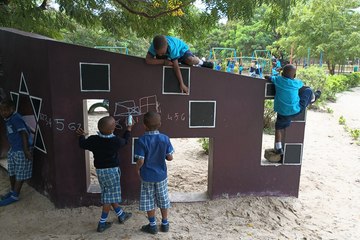
Children attending Pre-school in Tanzania benefit from the research project of Bethany Wilinski of MSU and Subilaga M Kejo of University of Dar es Salaam.
Tucheze Pamoja: Co-Creating Feasible and Sustainable Play-based Learning Approaches in Tanzania
Research leads: Bethany Wilinski (MSU), Subilaga M Kejo (UDSM)
Institutional partners: Michigan State University (College of Education), University of Dar es Salaam
Funding tier: Scaling grant (up to $100,000)
Promoting Science Communication and Engagement through Training and Digital Media Platforms
Research leads: Susan McFarlane-Alvarez (MSU), Dikabo Mogopodi (UB)
Institutional partners: Michigan State University (College of Communication Arts and Sciences), University of Botswana
Funding tier: Planning grant (up to $50,000)
“We were extremely impressed with the quality and diversity of proposals we received for this cycle of the PIRA program. The projects that were awarded all embody AAP’s commitment to innovation, equitable partnership, and our shared vision of transforming lives in Africa and beyond,” said Amy Jamison, co-director of the Alliance for African Partnership.
A unique aspect of PIRA grants is the expectation that institutions will establish and develop equitable partnerships from conception to close out of their respective projects. These equitable partnerships will be among the research team members themselves and include relevant local stakeholders. Teams will involve these local stakeholders as appropriate throughout the project, respecting their knowledge and expertise, and taking an adaptive approach that is responsive to the local context.
We invite you to join our virtual PIRA launch and showcase event at 8 a.m., Tuesday, Feb. 25 when all of our awardees will be discussing their projects. You can register for the event on Zoom.For more information, visit the Alliance for African Partnership website.
By:
Justin Rabineau
Monday, Jan 27, 2025
AGRI-FOOD SYSTEMS
+6
Leave a comment
Multidimensional impact of environmental change in the African Great Lakes
Recorded on March 24th, 2023 as part of AAP Public Dialogue Series
By:
Justin Rabineau
Monday, Jan 27, 2025
WATER, ENERGY, AND THE ENVIRONMENT
Leave a comment
Leveraging Demand Driven Research for Evidence Based Policymaking and Program Development
Recorded on June 2nd, 2023
By:
Justin Rabineau
Monday, Jan 27, 2025
CULTURE AND SOCIETY

Leave a comment