

Feed
-
Conference on Higher Education Advances (HEAd’22)After the great success of the last HEAd conference, with 200 participants from more than 50 countries, we are pleased to announce the Eighth International Conference on Higher Education Advances (HEAd’22), as a virtual and face-to-face conference, simultaneously. This conference is a consolidated forum for researchers and practitioners to exchange ideas, experiences, opinions and research results relating to the preparation of students, teaching/learning methodologies and the organization of educational systems. Topics of interest include, but are not limited to, the following topic areas: Innovative materials and new tools for teaching Teaching and learning experiences Educational technology (e.g., virtual labs, e-learning) Evaluation and assessment of student learning Emerging technologies in learning (e.g., MOOC, OER, gamification) Scientific and research education Experiences outside the classroom (e.g., practicums, mobility) New teaching/learning theories and models Globalization in education and education reforms Education economics Entrepreneurship and learning for employment Education accreditation, quality and assessment Competency-based learning and skill assessment Participants from all over the world are expected to present their latest and unpublished research findings. The program committee encourages the submission of articles that communicate applied and empirical findings of interest to higher education professionals. The HEAd’22 conference will be held on June 14-17, 2022 and hosted by the Faculty of Business Administration and Management of the Universitat Politècnica de València (UPV), which has been recently ranked as the best technical university in Spain by the Academic Ranking of World Universities (ARWU) 2021. Valencia is the third largest city in Spain and is located on the shore of the Mediterranean Sea. It is the capital city of the Comunitat Valenciana region, which is major tourist destination in summer, and we recommend the visit once the pandemic is over. The organizing committee looks forward to welcoming you all to a fruitful conference with open discussions and important networking to promote high quality education. In case of questions related to the conference, please contact us at headconf@upv.esBy: Raquel AcostaTuesday, Jan 18, 2022CULTURE AND SOCIETY+1

-
Apply for the next competition of the Carnegie African Diaspora Fellowship ProgramThe Institute of International Education (IIE) is pleased to announce that the next round of competition for the CADFP is now open.Apply now or share this message with those who might be interested. What is the CADFP?The CADFP is a scholar exchange program for African higher education institutions to host a diaspora scholar for 14-90 days for projects in curriculum co-development, research collaboration and graduate student teaching and mentoring. Who is eligible? Accredited universities in Ghana, Kenya, Nigeria, South Africa, Tanzania and Uganda, and member institutions of the African Research Universities Alliance (ARUA) (including Addis Ababa University, Ethiopia; the University of Rwanda; Cheikh Anta Diop University, Senegal; and University of Mauritius) can submit a project request to host a scholar. Scholars born in Africa, who live in the United States or Canada and work in an accredited college or university in either of those two countries, can apply online to be placed on a roster of candidates for a fellowship. Scholars must hold a terminal degree in their field and may hold any academic rank. How do I apply?Links and information about the African host institution project request application, scholar roster application and review guidelines are posted on the CADFP website. Interested parties are invited to register for one of our informational webinars: Information for Diaspora Scholars, Webinar #1: Thursday, January 13 at 11 AM Eastern US TimeInformation for Potential Hosts: Wednesday, January 19 at 10 AM South Africa Standard TimeInformation for Diaspora Scholars, Webinar #2: Thursday, January 27 at 12 noon Eastern US Time After the webinars, we will post a recording on our YouTube Channel. TimelineThe deadline for project requests from host universities and scholar applications for diaspora scholars is February 28, 2022 at 11:59 pm EST. Selection decisions will be made in March-April 2022; project visits can begin as early as June 1, 2022 and must be completed by November 30, 2023. BenefitsSelected fellows receive a $150/day stipend, visa costs, limited health insurance, round-trip international air travel and ground transportation costs to and from home and the U.S./Canadian airport. Selected Host Fellows and Diaspora Fellows can apply for supplemental funds to be used for fieldwork, publication costs and workshops. The CADFP Team manages the fellowships and payments to fellows. Host institutions are encouraged to provide cost-share for the fellow’s meals, lodging and in-country transportation.For more information on the fellowship program and application process, as well as the projects of current fellows, please write to us at AfricanDiaspora@iie.org visit our website and our communities on Facebook and Twitter.By: Raquel AcostaFriday, Jan 7, 2022EDUCATION
 No Preview Available
 -
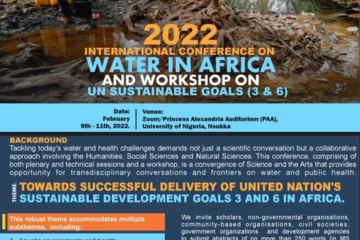
2022 International Conference on Water in Africa2022 International Conference on Water in Africa and Workshop on UN Sustainable Goals (3 & 6) Date: February 9th - 11th, 2022. Venue: Zoom/Princess Alexandria Auditorium (PAA), University of Nigeria, Nsukka Background Tackling today’s water and health challenges demands not just a scientific conversation but a collaborative approach involving the Humanities, Social Sciences and Natural Sciences. This conference, comprising of both plenary and technical sessions and a workshop, is a convergence of Science and the Arts that provides opportunity for transdisciplinary conversations and frontiers on water and public health. Theme: Towards Successful Delivery of United Nation’s Sustainable Development Goals 3 and 6 in Africa. This robust theme accommodates multiple subthemes, including: Aquatic environments and health: Water, sanitation and hygiene (WASH) Water treatment and wastewater treatment Water and theatre for development (TfD) Water education, literacy and awareness Water management and governance Water, agriculture and food security Water, women and gender concerns Water security and climate change Water risk and resilience assessments Hydrogeology, hydro-informatics and modelling Bioactive agents from aquatic ecosystems Bioenergy and biochemicals from wastewater Abstract submission We invite scholars, non-governmental organisations, community-based organisations, civil societies, government organizations and development agencies to submit abstracts of no more than 250 words (in MS Word, single-line spacing and Time New Roman font 12) to the conference email (waterconference@unn.edu.ng). The deadline for abstract submission is January 21,22 Contact the organizers via email (waterconference@unn.edu.ng)By: Vincent ChigorThursday, Jan 6, 2022WATER, ENERGY, AND THE ENVIRONMENT
-
Ufahamu: A Journal of African Studies, Call for SubmissionsCALL FOR PAPERS CLOSES FEBRUARY 15TH SEND SUBMISSIONS TO UFAHAMU@GMAIL.COM CALL FOR PAPERS FOR UFAHAMU DUE FEB. 15, 2022 The editors of Ufahamu: A Journal of African Studies are currently accepting submissions for Volume 43, Issue 2. In honor of the journal’s recent 50th anniversary of publication, this special retrospective issue will include republished essays from the back catalog alongside new submissions including, but not limited to: Essays Poems Book reviews Visual arts This call gives special consideration to those submissions which directly engage with the themes covered in the first decades of Ufahamu’s publication. Examples include direct engagement with a previously published article in Ufahamu, a paper written through citations of past Ufahamu writings, or any submission addressing themes such as: Anti-colonialism National liberation Consciousness Pan-Africanism Black Marxisms Diaspora Activist-intellectualism and much more! The editors are also soliciting articles concerning contemporary political issues in Africa and the diaspora in the spirit of Ufahamu’s original activist-academic ethos. Ufahamu’s full catalog is freely available and digitized at https://escholarship.org/uc/international_asc_ufahamu/1/1 For more information about Ufahamu, please visit https://international.ucla.edu/asc/ufahamu ---------------- Information forwarded by the UCLA African Studies Center – www.international.ucla.edu/africaBy: Raquel AcostaWednesday, Jan 5, 2022CULTURE AND SOCIETY+1
 No Preview Available
 -
International Feminist Journal of Politics-Asian Center for Women’s Studies Ewha Womans UniversityWe invite participants to this multi-location hybrid conference, ‘Remapping the feminist global’ co-convened by International Feminist Journal of Politics and Asian Center for Women’s Studies, Ewha Womans University.By: Raquel AcostaWednesday, Jan 5, 2022CULTURE AND SOCIETY
-
Support for Summer Akan, Swahili, Wolof StudyIndiana University is accepting applications for fellowships and scholarships to support study in its intensive summer programs in Akan, Swahili or Wolof in summer 2022. Courses are offered in an in-person/online hybrid format or a fully online format. Participants may also join a 1-credit African Studies course in English: "Military Engagement and Global Power Competition in Africa." All participants pay in-state tuition and earn 6-10 credits. Several scholarship and fellowship programs are available. Funding and priority admission application deadline is January 29, 2022. See http://languageworkshop.indiana.edu for course-by-course details and application forms. Questions? Write to us at languageworkshop@indiana.edu Read more or replyBy: Raquel AcostaFriday, Dec 17, 2021EDUCATION
 No Preview Available
 -
U.S. Embassy Bamako Public Diplomacy Annual Program StatementPAS Bamako invites proposals for projects that strengthen ties between the United States and Mali by promoting bilateral cooperation and highlighting shared values and shared interests. All programs must advance one of the key priorities listed below and must promote an element of American culture or have a connection with American expert/s, organization/s, or institution/s in a specific field that will promote increased ties between the United States and Mali and foster understanding of U.S. policies and perspectives. The PAS Small Grants program is NOT a vehicle to fund development projects, nor can these grants be used to support for-profit entities. Examples of PAS Small Grants Program projects include, but are not limited to: Artistic and cultural workshops, joint performances, and exhibitions Academic and professional lectures, seminars, and speaker programs Cultural heritage conservation and preservation programs Civic engagement and social activism programs Key Priority Areas and Audiences The purpose of projects funded under the annual program statement is to strengthen ties between Americans and Malians as we work together to make progress toward the goals outlined below. Strengthening independent media and fighting disinformation through media literacy, training and other engagement; Reinforcing existing Sister City relationships or other relationships between U.S. and Malian institutions (e.g. universities or museums) Ensuring participation of citizens, especially women and youth, in the democratic process; Fostering economic growth and entrepreneurship; Advancing anti-corruption efforts and promoting transparency and good governance; Promoting inclusive social development, particularly by empowering women and girls; Engaging underserved populations, including persons with disabilities, through art, sports, culture and other creative programs; Promoting tolerance and peace; Strengthening community resilience to extremism; and Promoting English language study and acquisition. For more information or to apply visit grants.govBy: Derek TobiasThursday, Dec 16, 2021CULTURE AND SOCIETY

Leave a comment