

Feed
-
OpportunityCall for Papers for the Eighteenth Global Studies ConferenceAll presenters are also encouraged to submit their paper to the companion journal, The International Journal of Interdisciplinary Global Studies. Find out more about the journal and submission process. Important DatesWe welcome the submission of proposals at any time of the year. The dates below serve as a guideline for proposal submission based on our corresponding registration deadlines. All proposals will be reviewed within two to four weeks of submission. Upcoming Proposal & Registration Dates Upcoming Proposal Deadline Advance 2 September 2024 Upcoming Registration Deadlines Advance 2 October 2024 Early 2 January 2025 Submit a proposal by 2 September 2024 Sincerely,Dr. Cristina Castillo RodríguezConference ChairUniversity of Málaga, SpainDr. Rafal SoborskiResearch Network ChairAssociate Professor, International Politics, Richmond, The American International University in London, UKDr. Phillip Kalantzis-CopeChief Social ScientistCommon Ground Research Networks, United StatesBy: Jayden HewittTuesday, Jun 25, 2024EDUCATION
 No Preview Available
 -
PostGood afternoon all. I am writing to you from Mattu University, Ethiopia. Mattu University is seeking Institutions to collaborate with.By: Habtamu AmessaWednesday, Jun 19, 2024AGRI-FOOD SYSTEMS+3

-
OpportunityPhD Scholarship @International Studies Group, University of the Free State, June 2024 [Announcement]Alessandro De Cola Location South Africa University of the Free State, International Studies Group PhD Studentships The International Studies Group (ISG) at the University of the Free State, Bloemfontein, South Africa, has vacancies for PhD studentships starting in February 2025. The stipend is ZAR 200,000 per annum. Studentships are for three years, subject to satisfactory progress. Headed by Professor Ian Phimister, the ISG comprises research associates, contract positions, post-doctoral fellows and PhD students. The group specialises in Central and Southern African history, but applications are also encouraged from candidates with research interests that engage with broader themes in imperial and global history. Essential Criteria: MA with distinction or merit A clear research proposal for doctoral work Application Process Applicants are asked to send a CV, along with a cover letter outlining their suitability for the position, and a research proposal. This should be emailed as one document to Ms Tari Gwena gwenat@ufs.ac.za by 15 July 2024. In addition, applicants should arrange for three letters of recommendation to be sent to the above address by 22 July 2024. Successful candidates will be notified by 5 August 2024. If you do not hear anything by this date then please assume your application has been unsuccessful.By: Jayden HewittWednesday, Jun 12, 2024EDUCATION
No Preview Available -
OpportunityCIES 2025 CALL FOR PAPERS AND PARTICIPATIONCIES 2025 CONFERENCE THEME:ENVISIONING EDUCATION IN A DIGITAL SOCIETY CIES 2025 will be held between March 22-26, 2025, at the Palmer House in Chicago, Illinois, United States, both face-to-face and virtually. The conference website is open with initial details about the theme, the call for papers and participation, and some preliminary details about the conference site. Over the next few weeks, we will continue to share exciting details about both aspects of the conference on the conference website. We look forward to a robust and intellectually stimulating conference. The CIES All Academic portal requires some technical and logistical maintenance to ensure a seamless and efficient process for accepting and reviewing proposals. As such, the portal will open very soon, and we will keep the CIES community updated on the system's launch. In the meantime, please visit the website for details about the call and the conference. Please note that, this year, the deadline for submission will be September 10, 2024, with NO EXTENSIONS! In the coming weeks, we plan to share exciting details, important timelines, and information that will help you plan for a professionally and personally satisfying CIES experience. Rest assured, we are meticulously planning every aspect of CIES 2025 to ensure a rewarding experience for all participants. Please email the conference team at conference@cies.us if you have any questions! Thank you!The CIES 2025 Core Conference Planning Team Halla B. Holmarsdottir, 2025 Conference Chair and CIES President-electMildred Cabrera – Conference ManagerMelissa Raslevich, Conference CoordinatorJennifer Olson, Senior Program CoordinatorLeyla Hasanova, Assistant Program CoordinatorBy: Jayden HewittWednesday, Jun 12, 2024EDUCATION
No Preview Available -
OpportunityCIES 2025 CALL FOR PAPERS AND PARTICIPATIONCIES 2025 CONFERENCE THEME:ENVISIONING EDUCATION IN A DIGITAL SOCIETY CIES 2025 will be held between March 22-26, 2025, at the Palmer House in Chicago, Illinois, United States, both face-to-face and virtually. The conference website is open with initial details about the theme, the call for papers and participation, and some preliminary details about the conference site. Over the next few weeks, we will continue to share exciting details about both aspects of the conference on the conference website. We look forward to a robust and intellectually stimulating conference. The CIES All Academic portal requires some technical and logistical maintenance to ensure a seamless and efficient process for accepting and reviewing proposals. As such, the portal will open very soon, and we will keep the CIES community updated on the system's launch. In the meantime, please visit the website for details about the call and the conference. Please note that, this year, the deadline for submission will be September 10, 2024, with NO EXTENSIONS! In the coming weeks, we plan to share exciting details, important timelines, and information that will help you plan for a professionally and personally satisfying CIES experience. Rest assured, we are meticulously planning every aspect of CIES 2025 to ensure a rewarding experience for all participants. Please email the conference team at conference@cies.us if you have any questions! Thank you!The CIES 2025 Core Conference Planning Team Halla B. Holmarsdottir, 2025 Conference Chair and CIES President-electMildred Cabrera – Conference ManagerMelissa Raslevich, Conference CoordinatorJennifer Olson, Senior Program CoordinatorLeyla Hasanova, Assistant Program CoordinatorBy: Jayden HewittWednesday, Jun 12, 2024EDUCATION
No Preview Available -
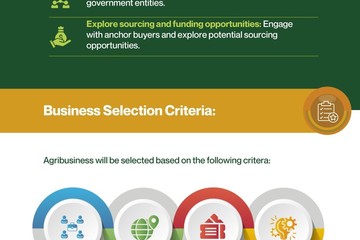
OpportunityJoin the Agribusiness Deal Room 2024Are you a MSME interested in championing food systems in Africa? Are you an African Agri food business with a game-changing approach to revolutionize food systems on the continent? Are you looking for investment opportunities ? Is your Agri food business ready to scale ?Are you driving innovation in Africa's agribusiness sector?Is your Agri food business poised for growth and scale? Are you driving innovation in Africa's agribusiness sector?Is your Agri food business poised for growth and scale? Is your Agri food business poised for growth and scale? The AFS Forum is looking for innovative youth and women led MSMEs that promote food systems transformation in Africa. Whether you're empowering smallholder farmers to increase their production, processing and marketing, advancing nutrition, health and diets, or streamlining market access, managing food waste …. we're looking for MSMEs like yours. Agribusiness will be selected based on the following critera: Sector: Agrifood businesses with a clear link to smallholder farmers. This could include, but is not limited to, companies involved in the provision of inputs, primary production, enabling (e.g., agriculture logistics, aggregation platforms, irrigation, cold storage, financial services), value addition, digital platforms, market access, nutrition, post-harvest management, renewable energy etc. Country: The enterprise must be directly active within the African continent or be planning to expand into the region in the next 12-18 months. Stage of business: Post-revenue/proof of concept with a product in the market and an existing customer base. The enterprise must have plans to scale operations in the next 12-24 months. Enterprises must have a clear business model and must also be looking for financing (e.g., debt, equity financing, etc.) Ticket size: Investment under 100,000 USD 100,000 USD to 500,000 USD, 500,000 USD to 1 million USD Above 1 million USD Financial instruments such as loan, grant, equity, guarantee, reimbursable grant. Innovation in agri-food systems: The proposal should demonstrate innovation, impact, and scalability it can brings to address low production, digital gap, environment and climate challenges, nutrition challenges. Application RequirementsIf you meet the above criteria, please click here to fill the template to submit your profile. Given the limited number of slots available, applications will be on a first-come, first-served basis and only SMEs that submit fully completed profiles will be considered for participation. HOW TO APPLY: If your business meets the above criteria, we invite you to fill out the profile submission template hereBy: Jayden HewittTuesday, May 21, 2024AGRI-FOOD SYSTEMS
-
OpportunityCFAs: Global Health Policy and Systems Research (HPSR) ProjectsThe National Institute for Health and Care Research (NIHR) is pleased to launch Global Health Policy and Systems Research (HPSR) Projects to support high quality applied health research to strengthen health policy and health systems in ODA-eligible countries on the Development Assistance Committee (DAC) list.https://www.nihr.ac.uk/funding/global-health-policy-and-systems-research-hpsr-projects-call-2/35549By: Tony MilanziMonday, May 20, 2024HEALTH AND NUTRITION
No Preview Available

Leave a comment