

Feed
-
Digital Communications Workshop at LUANARAAP is proud to highlight the new digital strategy work recently accomplished with our affiliates at @LUANAR led by AAP’s communications coordinator @Wisdom Nelson Chimgwede. LUANAR has currently moved to improve dissemination of best practices including research findings through digital means. Speaking at a web, social media and on-line content management training the University’s Vice Chancellor Professor Emmanuel Kaunda said the development is aimed at enhancing the university’s relevance among farmers and stakeholders in the provision of the much needed information and knowledge on agricultural transformation. Through its affiliation with AAP, LUANAR identified some gaps revealing the need to strengthen the communications functions and AAP has offered to provide technical assistance through the communications section at the university. Attached is a video feature from the workshop.By: Raquel AcostaThursday, Sep 16, 2021OTHER
-
Mali’s roadmap for lasting peace has laudable goals: but it doesn’t go far enoughSteve Esquith, one of the PIs during the first round of AAP Transformation Institutions Strategic Partnership Grants and an African Futures mentor, has recently published an article within @TheConversation. This article is related to his peace-building work achieved under the grant. We encourage colleagues to read through his review of Mali’s new government action plan. Read the article: https://theconversation.com/malis-roadmap-for-lasting-peace-has-laudable-goals-but-it-doesnt-go-far-enough-166419By: Raquel AcostaTuesday, Sep 14, 2021CULTURE AND SOCIETY

-
East and Southern Africa Fertilizer Financing ForumThe Africa Fertilizer Financing Mechanism (AFFM), in collaboration with the African Fertilizer and Agribusiness Partnership (AFAP) and AFRIQOM, will be hosting the first virtual edition of the East and Southern Africa Fertilizer Financing Forum on Thursday, 28 October 2021. The event has been themed “Strengthening Regional Collaboration to Finance Fertilizer in the Agribusiness Value Chain”, and will facilitate the identification of opportunities for building and fostering partnerships with sectorial stakeholders in order to enhance access to finance and agricultural productivity in East and Southern Africa. The East and Southern Africa Fertilizer Financing Forum will bring together regional member countries, regional and international development and commercial financial institutions, farmers, private sector, and non-governmental organizations. The goal will be for participants to deliberate on potential solutions to existing bottlenecks to fertilizer financing. Delegates will also discuss ways to scale up funding in the region by leveraging the African Continental Free Trade Area (AfCFTA) initiative and other existing success stories. Click here to register for the eventBy: Derek TobiasThursday, Sep 9, 2021AGRI-FOOD SYSTEMS

-
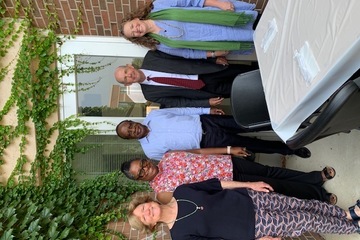
Connecting with Prof Ayiro and Daystar UniversityProfessor and Vice Chancellor Laban Ayiro from Daystar University, Provost Teresa Woodruff, ISP Dean Steve Hanson, AAP leadership, and faculty in the College of Communications Arts and Sciences had the opportunity to meet Aug 24. Prof Ayiro met with leadership from the College of Communications and the KEY Team to discuss potential collaborative relationships. AAP is grateful for connecting with Prof Ayiro and Daystar University. Attached are photos from the event and lunch with Prof. Ayiro capturing Provost Teresa Woodruff, Professor Laban Ayiro, ISP Dean Steve Hanson, AAP Director Jose Jackson-Malete, AAP Director, Amy Jamison, Prof. David Ewoldsen, and Prof. Nancy Rhodes.By: Raquel AcostaThursday, Sep 9, 2021EDUCATION
-
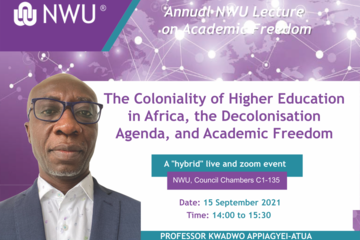
LECTURE: Coloniality of Higher Education in Africa, the Decolonisation Agenda, and Academic FreedomYou are cordially invited to the Annual NWU Lecture on Academic Freedomby Prof. Kwadwo Appiagyei-Atua, School of Law, University of Ghana,Legon, Accra.Topic: The Coloniality of Higher Education in Africa, theDecolonisation Agenda, and Academic FreedomDate and time: 15 September 2021, 14:00 to 15:30 SAST If you wish to attend by zoom, please RSVP here:https://urldefense.com/v3/__https://us02web.zoom.us/webinar/register/WN_45iNwZg9THawSADRufGyPA__;!!HXCxUKc!kPN0uvfLvGQ2OI8pyHfemNnhy1vtZVtyWJf3S_H1PlMaNUwFKaopZgNXOtevBAY$ (the event link will be provided to you)By: Annemi ConradieThursday, Sep 9, 2021EDUCATION
-
Building Sustainable Research Management Capacity in Sub-Saharan Africa: AAP Co-director PublishedCo-director of AAP MSU Office, Jose Jackson-Malete, has recently had a chapter published! “Building Science Systems in Africa” is a culmination of a project focused on building capacity of African science councils to collaborate with each other and the private sector. The project was led by the African Centre for Technology Studies, the Science, Technology, and Innovation Policy Research Organization (STIPRO), the Scinnovent Centre, and the Association of African Universities. Jose Jackson, alongside co-authors Karin Dyason, Dipalesa Mpye, and Zimasa Sobuza, wrote the chapter “Building Sustainable Research Management Capacity in Sub-Saharan Africa” which discusses the increasing professionalization of research management. The e-book is made available open access on the ACTS website and also the SGCI website. https://www.acts-net.org/publications/books/building-science-systems-in-africaBy: Madeleine FutterFriday, Aug 27, 2021OTHER
 No Preview Available
 -
[RUFORUM Press Release] Seventh African Higher Education Week and RUFORUM Triennial ConferenceKampala 17 August 2021: The Regional Universities Forum for Capacity Building in Agriculture (RUFORUM) is pleased to announce the Seventh African Higher Education Week and RUFORUM Triennial Conference that will be hosted by the Government of the Republic of Benin in partnership with the University of Abomey Calavi, University of Parakou and the National University of Agriculture, from the 06th – 10th December, 2021 at Palais des Congres de Cotonou, Benin. The Seventh African Higher Education Week and RUFORUM Triennial Conference will run under the theme “Operationalising Higher Education for Innovation, Industrialisation, Inclusion and Sustainable Economic Development in Africa: A Call for Action” The conference will bring together participants from across Africa and the world to discuss how African universities are working toward improving their mandates of training, research and outreach, to produce innovations and entrepreneurial youth that meet the demands in the global competitive market. The participants will be drawn from Universities, Civil Society Organizations-CSOs, National and International Research Organizations, Development Partners, Governments, Continental and Regional Organizations, African Union Commission, Food and Agriculture Organization (FAO), Non-Governmental Organizations, the Private sector, farmers & farmer representatives, emerging & early career researchers, and young entrepreneurs from especially Benin and other West African countries. Universities, private sector actors and young entrepreneurs will have the opportunity to showcase their innovations, products and services. Due to the restrictions and risks associated with the COVID-19, African Higher Education Week and RUFORUM Triennial Conference is being organized using a blended approach, which will include both face-to-face and virtual meetings. RUFORUM will recognise farmers that have made significant contribution to agricultural transformation in Benin as a way of supporting national advancement and transformation of agriculture. RUFORUM shall also recognise scientists and other actors that have made significant contribution and supported the advancement of excellence in research and higher education for the development of Africa. Young Innovators and Entrepreneurs from Benin will be recognised to promote the contribution of the youth to the economic development of Africa and to provide youth with the forum to demonstrate their innovations. The Conference will be preceded by several virtual side events including: Scientific Data Management training for Post-Graduate Students Using R Programming Language, Evaluating the Impact of Entrepreneurship in Agribusiness Training, Social media training for students, Interdisciplinary Training for Early Career Scientists & doctoral students, and a business & entrepreneurship training for Young Innovators and entrepreneurs. This year, because of the COVID-19 restrictions and risks associated with travel during this period, it will not be possible for all delegates to travel to Benin to participate. Therefore, some delegates will be requested to participate virtually through an online platform. We have therefore designed the attendance Questionnaire for RUFORUM Triennial Conference 2021 to enable the organizers know your preference in terms of traveling to Benin or attending the event face to face or virtually. We will also be happy to get essential information about you to enable effective planning. This questionnaire is expected to take not more than 7 minutes of your time. Learn more: https://ruforum.wordpress.com/2021/08/19/press-release-seventh-african-higher-education-week-and-ruforum-triennial-conference/?utm_source=RUFORUM+Mailing+List&utm_campaign=d18db56afe-RUFORUM+Weekly+-+Vol.3+No.25_COPY_01&utm_medium=email&utm_term=0_1fcfbb8a0b-d18db56afe-346973753&ct=t()&goal=0_1fcfbb8a0b-d18db56afe-346973753&mc_cid=d18db56afe&mc_eid=d95cf18a8dBy: Madeleine FutterThursday, Aug 26, 2021AGRI-FOOD SYSTEMS+2
 No Preview Available

Leave a comment